PART ONE: POLITICAL PRIMER (1958)
This article, and several to follow, augment the Research | Lou Harrison page.
When Lou Harrison first received an invitation from Bob Hughes to supervise a concert of his music at the University of Buffalo, Harrison responded that he could not afford to go East. He did offer the premiere of four recitatives of his new work Political Primer, with texts in both Esperanto and English for a baritone or bass soloist, as the bottom of page 2 of his letter to Hughes of 14 March 1959 explains:
"Secondly, should you have at hand a good dramatic baritone, I would offer to you the 1st performance of 4 Recitatives from the very large work on which I continue to compose. These I am making in both English & Esperanto, & I would like that 3 be done in Esp'o [Esperanto] & one in English. Only the latter requires accompaniment (a brief passage for triangles, 2 clock-coils, grand tam-tam (or gong), & amplified Geiger-counter) the other 3 are to be . . . [sung without accompaniment]."
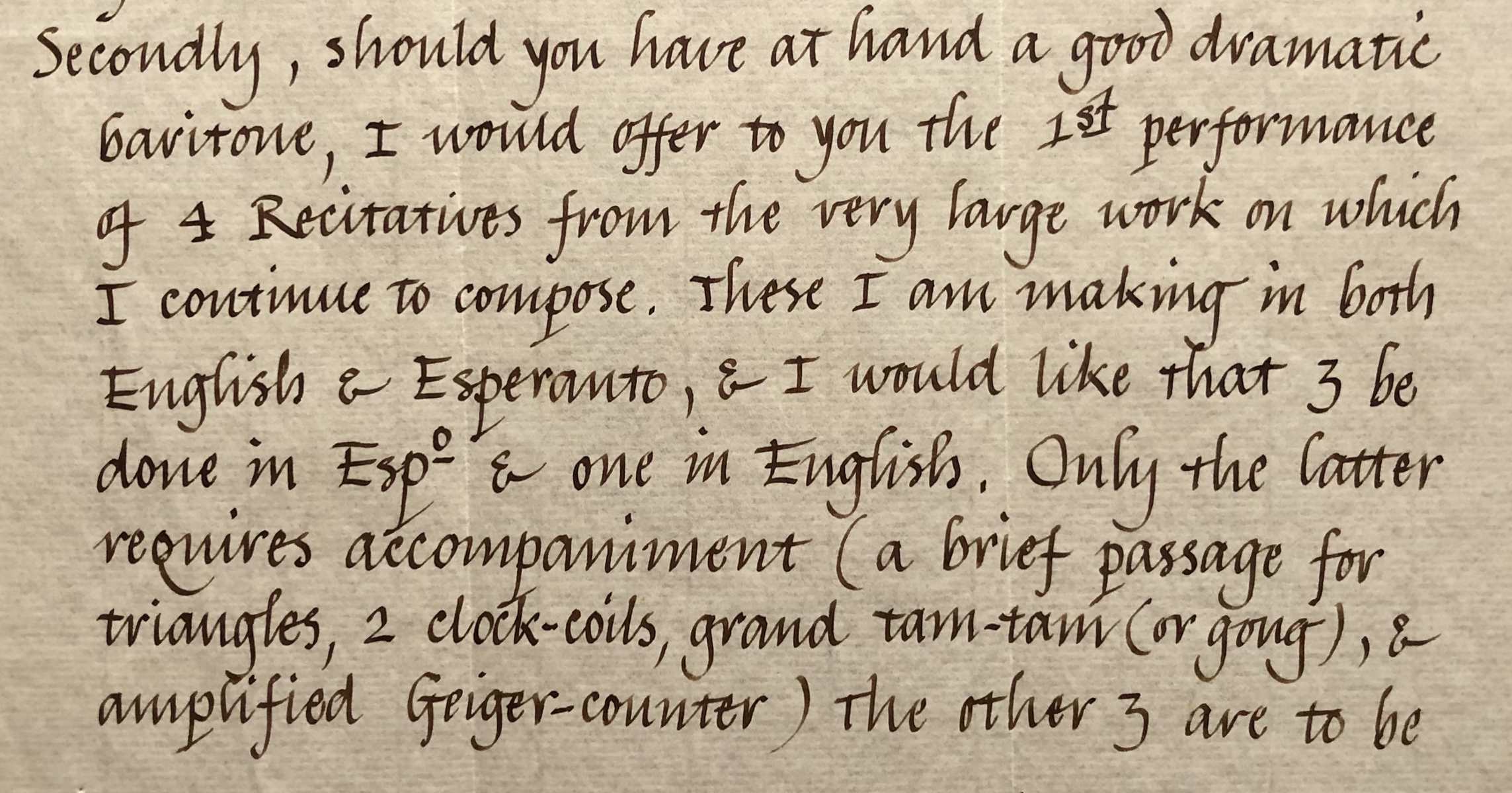
Letter, Harrison to Hughes, 14 March 1959, Robert Hughes Papers
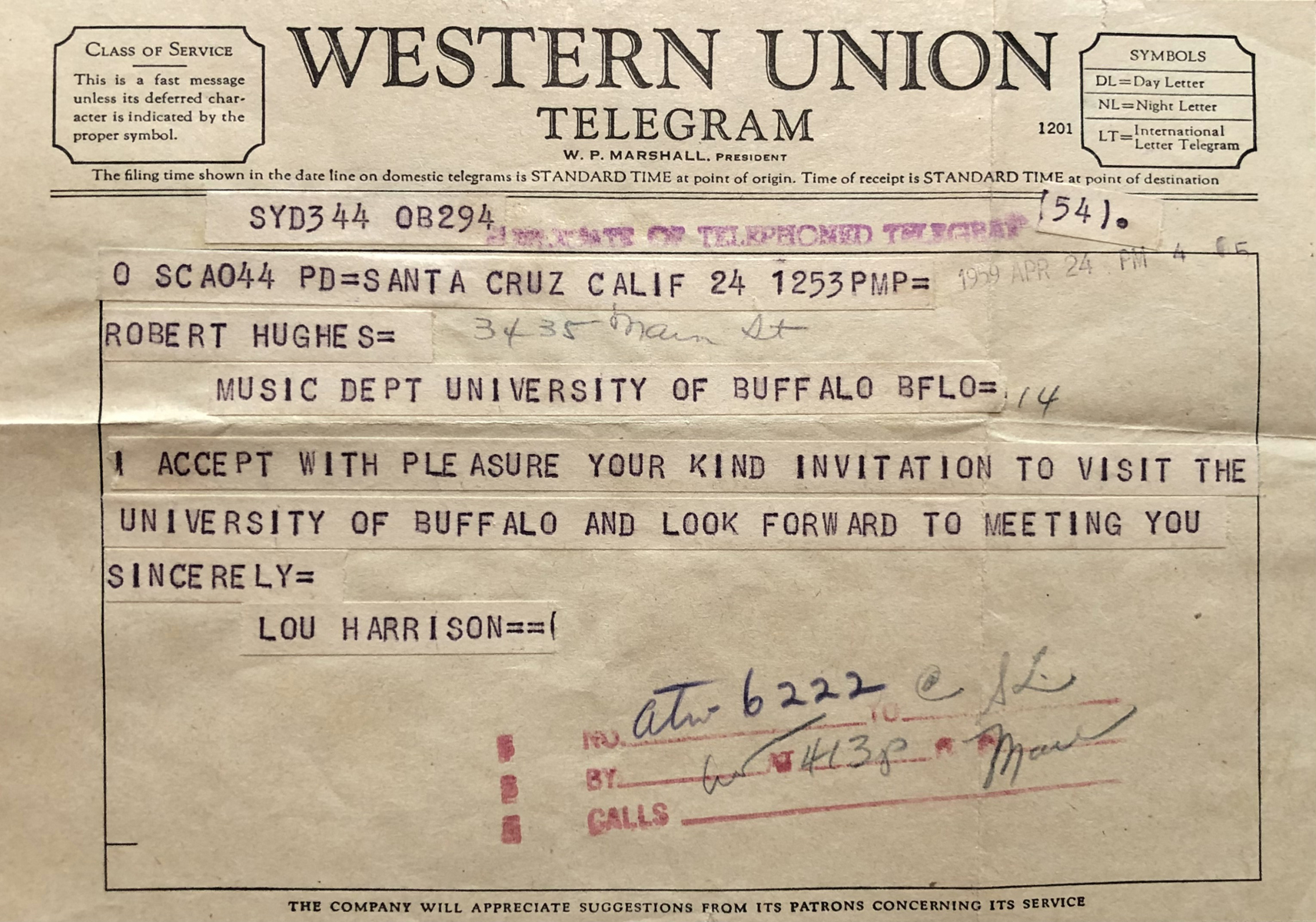
After a little more than a month, Harrison changed course and accepted the invitation. He sent this telegram to Hughes and to the Music Department at the University of Buffalo on 24 April 1959.
"I ACCEPT WITH PLEASURE YOUR KIND INVITATION TO VISIT THE UNIVERSITY OF BUFFALO AND LOOK FORWARD TO MEETING YOU SINCERELY LOU" Robert Hughes Papers
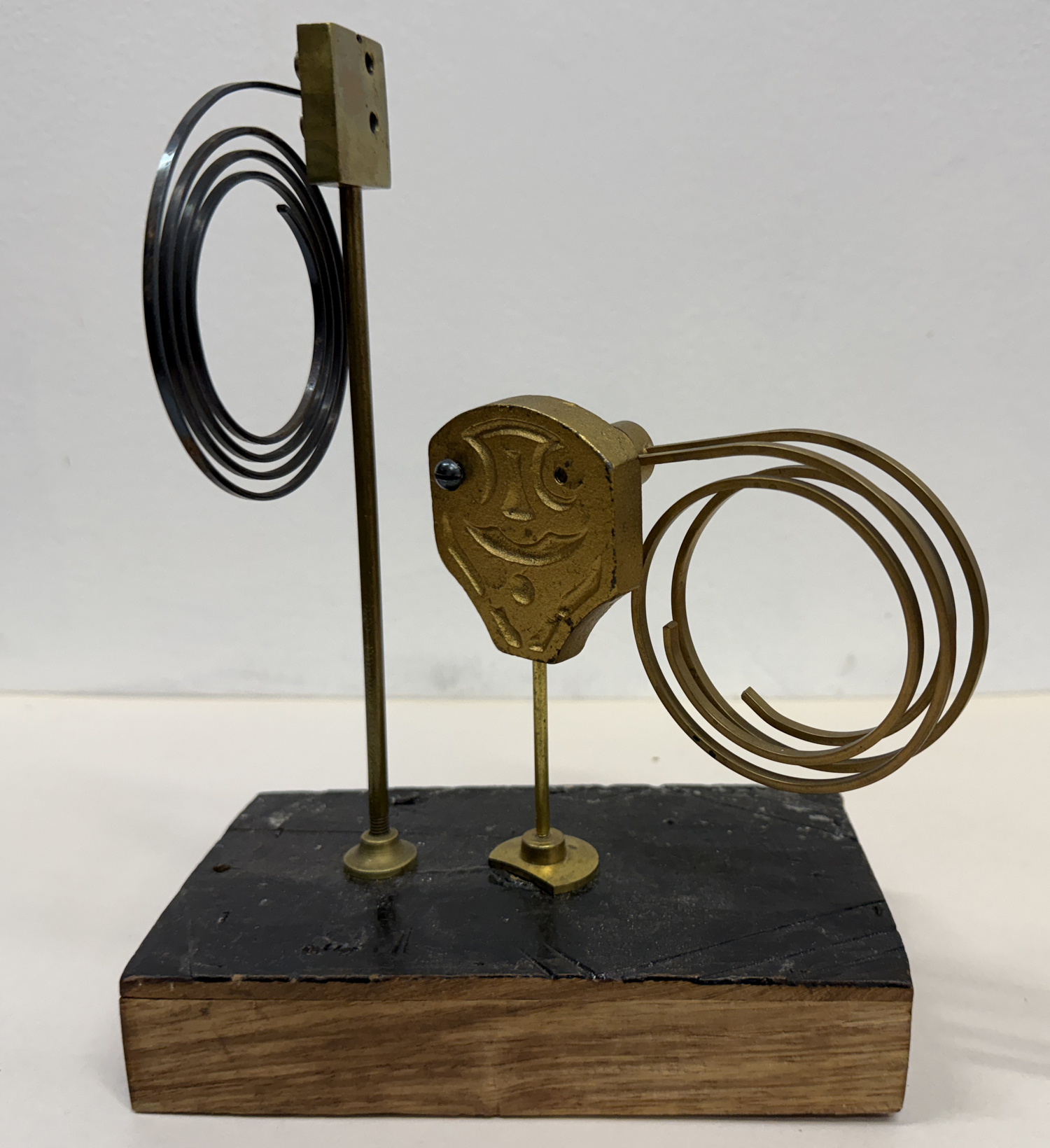
The Primer calls for clock coils sourced from grandfather clocks. At right are two clock coils used in a 2017 performance of Political Primer. The Harrison Centennial program was produced by Sarah Cahill for the Berkeley Art Museum at the University of California, Berkeley on 10 May 2017, with bass vocalist Richard Mix as the soloist. Robert Hughes Archive
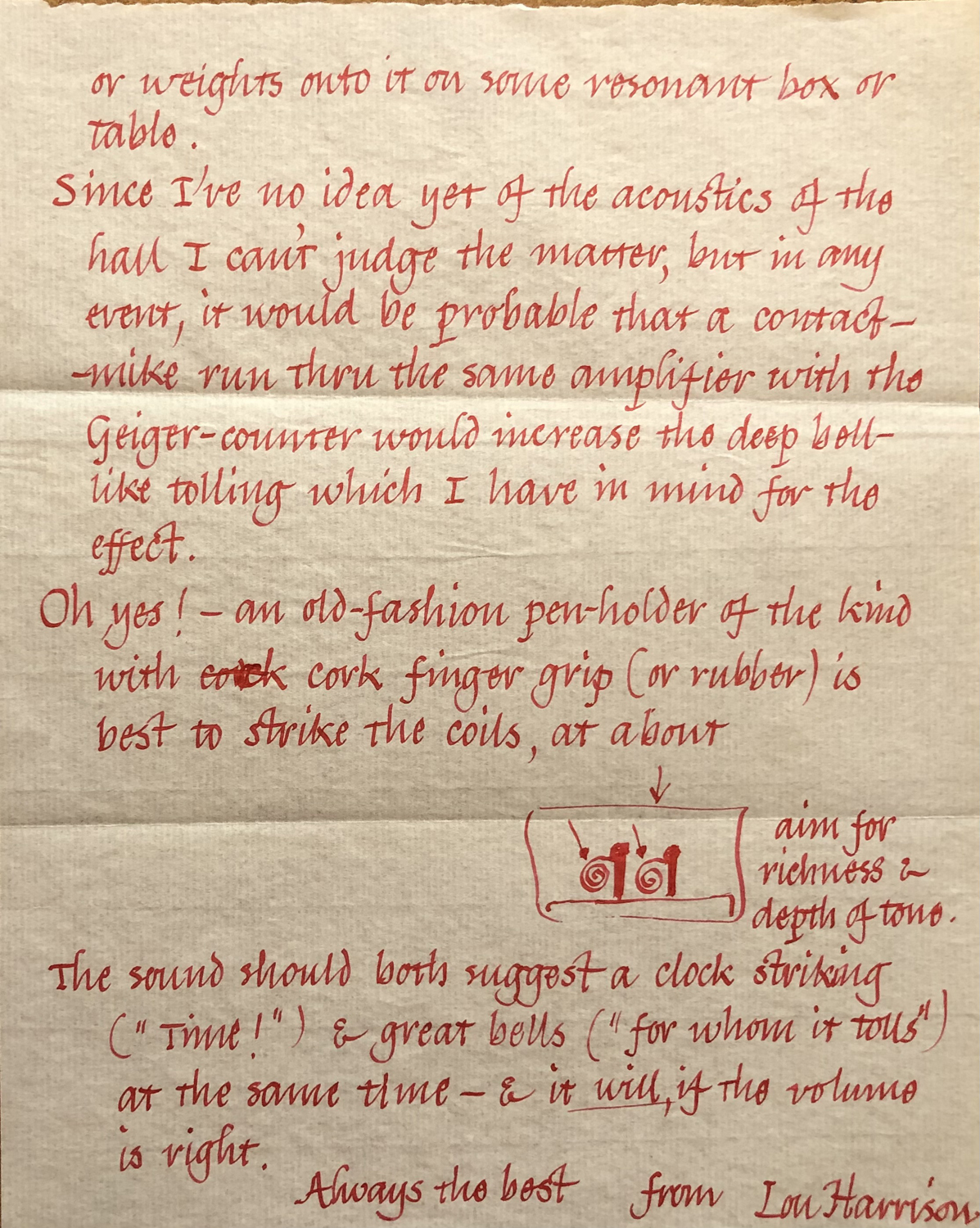
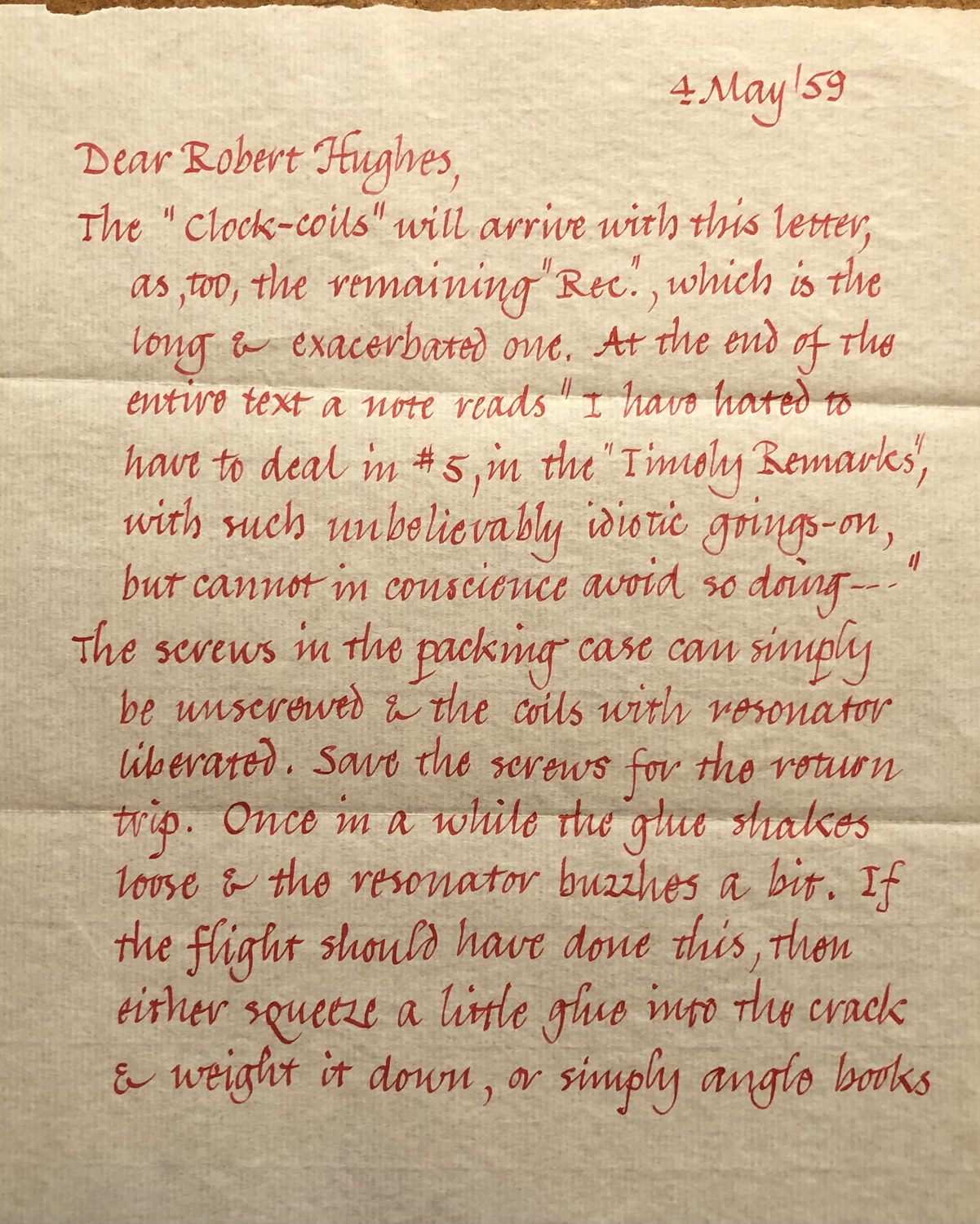
Letter, Harrison to Hughes, 4 May 1959
"Dear Robert Hughes, The 'clock-coils' will arrive with this letter, as, too, the remaining 'Rec.' [Recitative], which is the long & exacerbated one. At the end of the entire text a note reads 'I have hated to have to deal in #5, in the 'Timely Remarks,' with such unbelievably idiotic goings-on, but cannot in conscience avoid so doing—'. . . Oh yes!—an old-fashion [sic] pen-holder of the kind with cork finger grip (or rubber) is best to strike the coils . . . . The sound should both suggest a clock striking ('Time!') & great bells ('for whom it tolls') at the same time—& it will, if the volume is right. . . "
The rest of the letter concerns the assembly, maintenance and return of the coils to Harrison. A solution to the 'idiotic goings-on' that were so troubling to Harrison appears in the text of the 5th Recitative. It reads, "By & large, the separation of Church & State has proved a good thing, & since war is presently disturbing those who are not interested in it, a separation of War & State will be made. This will render wars harmless to those not interested in them, as churches are now harmless to those not interested in them. As to Human mercy in this matter, those of us who don't, must understand that a great many persons do enjoy war, & some not undistinguished & it is perfectly clear that while they should not be allowed to harm or bully those of us who enjoj [sic] other matters, neither should they be denied their pleasure." The text further suggests that a community maintain a modestly sized battleground for its warriors, according to the size of the group. Robert Hughes Archive
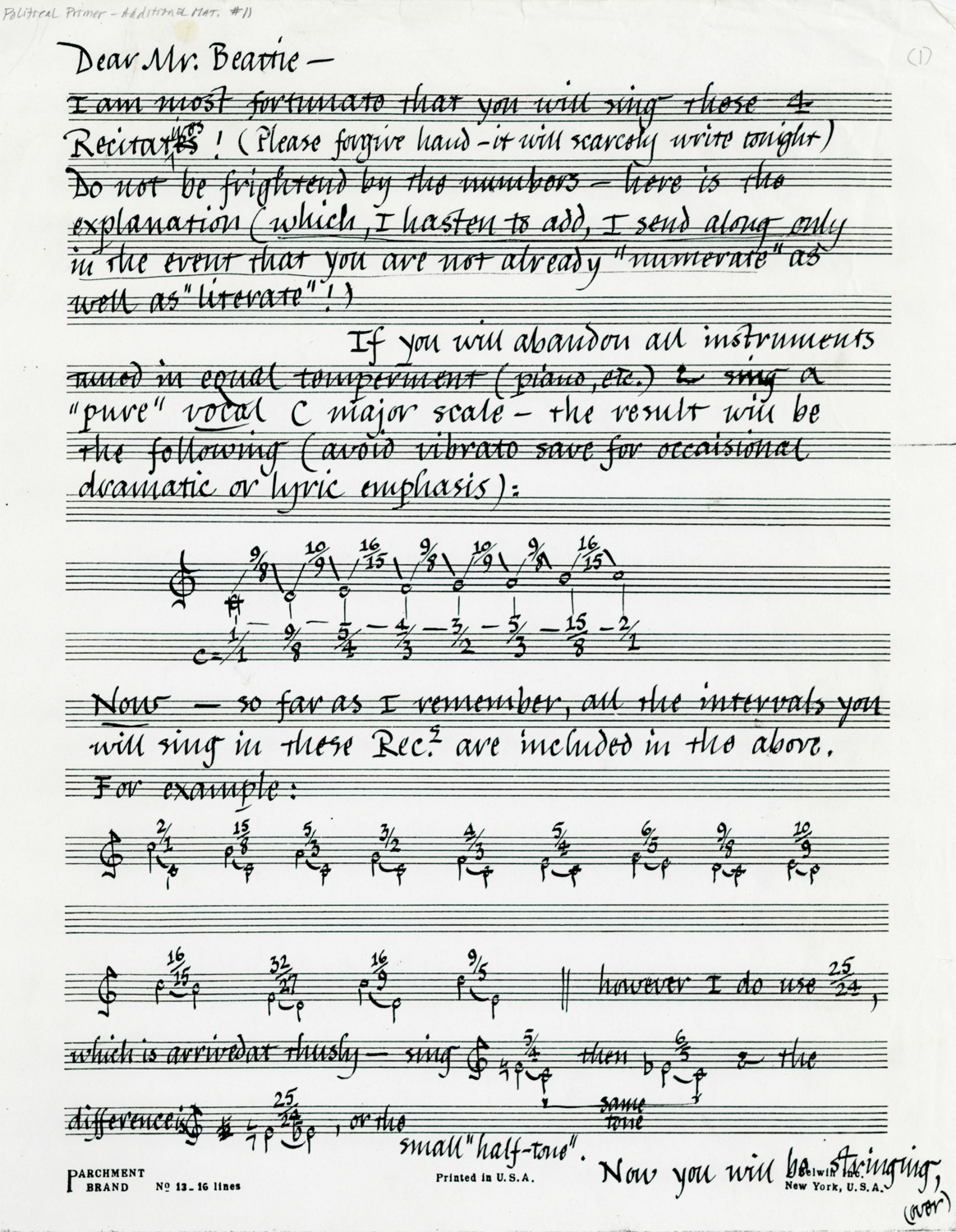
Among the Primer's many annotated score pages in the Robert Hughes papers is a copy of an undated letter from Harrison to Herbert Beattie, the baritone soloist for the University of Buffalo concert.
"Dear Mr. Beattie—I am most fortunate that you will sing these 4 Recitatives! (Please forgive hand—it will scarcely write tonight.) Do not be frightened by the numbers—here is the explanation (which I hasten to add, I send along only in the event that you are not already 'numerate' as well as 'literate'!)
If you will abandon all instruments tuned in equal temperment [sic] (piano, etc.) & sing a 'pure' vocal C major scale—the result will be the following (avoid vibrato save for occasional dramatic or lyric emphasis): [notation with ratios follows]
Now—so far as I remember, all the intervals you will sing in these Rec.s [Recitatives] are included in the above. For example: [notation with notes and ratios follow]
However I do use 25/24, which is arrived at thusly—sing [music notation and ratios] . . ." Robert Hughes Papers
In preparation for the 2017 concert in Berkeley, Hughes wrote to Richard Mix, the bass vocalist, "As Lou explains there [the letter to Herbert Beattie, above] the just intonation ratios are what the human voice generates when singing naturally. So just ignore them [the ratios] as you'll be singing them anyway." (email Robert Hughes to Richard Mix, 05 March 2017)
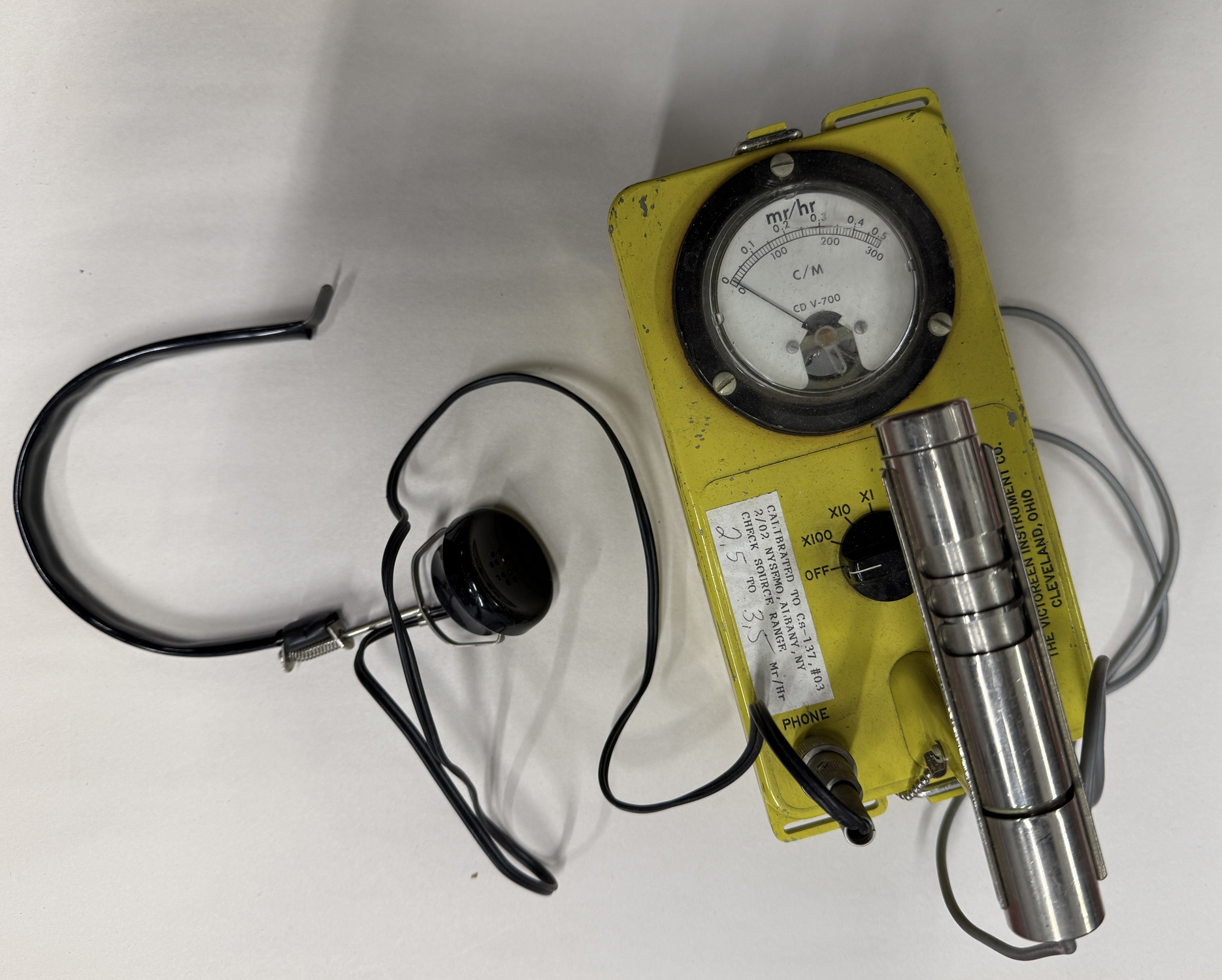
The Geiger counter is one of many instruments in the percussion battery used during a performance of Harrison's Political Primer.
The bass or baritone soloist explains to the audience that clicks produced by the Geiger counter register cosmic rays and also register "the sounds of class D poisons from nuclear tests, slowly settling down over the planet." The score requires a pause for the audience to hear the clicks.
Robert Hughes archive
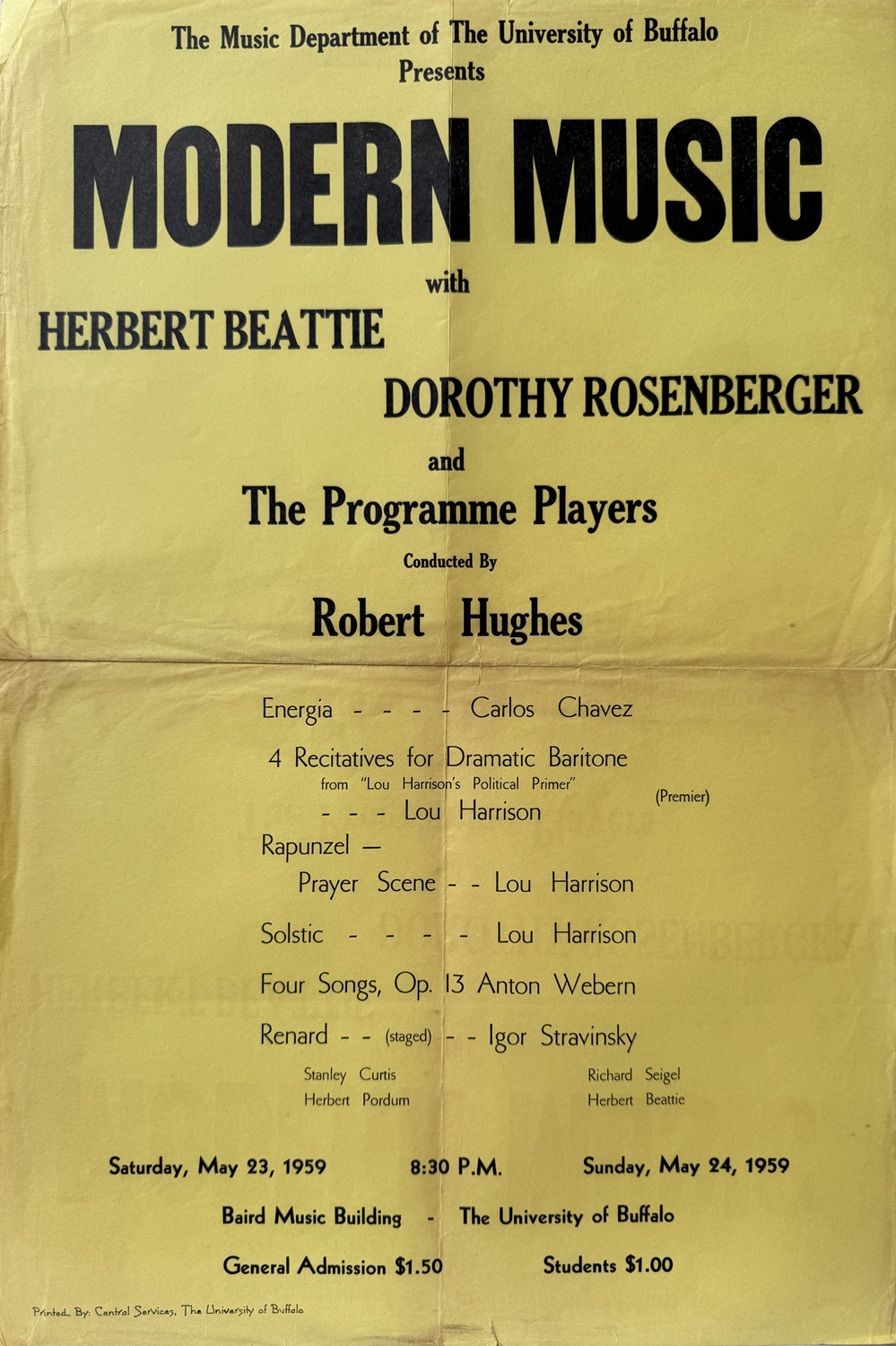
The poster announcement, seen above, for the Saturday, 23 May 1959 performance of three works by Harrison at the Baird Music Building at the University of Buffalo included 4 Recitatives for Dramatic Baritone from Lou Harrison's Political Primer, the Prayer Scene from Rapunzel, and Solstice. Works by Chavez, Webern and Stravinsky filled out the program. Robert Hughes Papers
Buffalo Evening News, May 1958
Harrison Concert Draws Ovation from Audience
"Harrison's music hushed the crowd into silent expectation of what was coming next. His tones and rhythms, so magnificently pulled from the musicians by Robert Hughes, played tickle and shiver games with the nerve ends and the spinal cord.
"His works are strongly oriental in rhythm and melody with the strong basis of the western world. His use of the Oriental microscales brings subtlety and beauty to the contemporary music without relying on the dissonant discord used by many contemporaries for shock. He shocks you, yes, but with the delicate shock of inspiration and understanding.
"I had to look at the stage to realize that many of these sounds were coming from bowls filled with water, brake drums, wash tubs or garbage cans which were sprinkled among harps, violins, pianos, cellos, trumpets or oboes. . . .
"Harrison's music is as indescribable as Harrison is himself. It is the expression of a man in love with music and handling it like a woman. He takes it and caresses it tenderly to make it bend and sway, or causes the sound to spring to life by removing the grey of lost and replacing it with the found of color. . . ." Ron Reeves
Robert Hughes Papers
M. Fisher, Trustee, Robert Hughes Papers, October 24, 2026
In the works, PART TWO:
Hughes & Harrison & A Stance on War, The Anti-War Concerts