“...a musical force of nature...” San Francisco Chronicle
ROBERT GROVE HUGHES (1933–2022) had a long and multi-faceted career as composer, conductor, performance artist, author and publisher, humanist and lecturer, and Italophile. His vision was sui generis and his compositional gamut wide—from virtuoso works for children’s films to electroacoustic and multi-perceptual experiments for orchestra. He maintained niche interests in Alaskan themes, the pairing of Asian and Western instruments, and radically-staged mixed-media events. Underlying every composition was a deep sense of camaraderie with his peers—the conductors, composers, and musicians with whom he worked—manifested as a challenge, tease, gift or showcase for their personalities and talents. A union musician from his late teens, he was widely sought as a bassoonist and contrabassoonist. His oeuvre is peppered with chamber works for unheard-of combinations among the bass clef instruments.
He was Composer-in-Residence with the San Francisco Symphony (1977) and the Rockefeller Bellagio Center (1989), and a Fulbright Scholar in Italy (1982), and a frequent visiting artist-scholar at the American Academy in Rome. He was inducted into the Buffalo Music Hall of Fame in 2004.
New and Electroacoustic Music
The pairing of pre-recorded electronic tape music with traditional Western instruments reflects the composer’s interest in new timbral experiences, heard through the ear of a tenured orchestral player with an abiding interest in the shared experience of making and listening to music. Notable works include: Quadroquartet (commissioned by the Cabrillo Music Festival), for four flutes, four French Horns, four double basses, and four audio speakers on the stage; Cones (jointly commissioned by Cabrillo and Oakland Ballet), for tape and orchestra, which opens with six and a half minutes of solo sounds from the Moog IIIP; Cadences (commissioned by the Oakland Symphony), for a spatially-deployed double orchestra and tape tracks containing of electronics and pre-recorded, politically-inflected comments by the youth orchestra players. Cadences was later choreographed by John Neumeier for the Hamburg Ballet.
Together, his six electroacoustic works for full orchestra and five for smaller ensembles—all composed over a relatively short period of seven years (1971 to 1977)—stand apart from the better-known postwar investigations of acoustics and technological innovation undertaken in academic or corporate electronic music laboratories.
As one of the Bay Area’s most active conductors of contemporary music, Hughes premiered and recorded mid- to late-twentieth-century works by Beth Anderson, Laurie Anderson, Robert Ashley, Henry Brant, Don Buchla, Luigi Dallapiccola, Robert Erickson, Lou Harrison, Andrew Imbrie, Peter Lopez, Robert Moran, Ami Radunskaya, Ned Rorem, Blue Gene Tyranny, and Olly Wilson. Recordings were issued on the CRI, New World, Cambridge, 1750 Arch, and Bomar labels. Though no premiere or recording was involved, Hughes memorably led the Lyon Opera Ballet in 1990 performances of two ballets by Frank Zappa.
Cabrillo Music Festival
Hughes is remembered most as the founder of ensembles whose mission was to upend traditional music programming. He extended the repertoire to composers who defied description, living Black American composers, poet-composers, and performance art or mixed-media creators. He co-founded the Cabrillo Festival of Contemporary Music with Lou Harrison in 1963, helping to secure the festival’s vibrant commitment to new music, which endures today.
Youth Chamber Orchestra: New and World Music
Hughes shaped a generation of emerging musicians by founding and directing the Youth Chamber Orchestra (YCO) in 1964, which expanded into the Oakland Symphony Youth Orchestra (OSYO). His programming and development for this group were unparalleled. The ensemble commissioned, toured and recorded new music. They staged mixed-media and film “happenings” in concert halls and site-specific environments. They performed music of the California Diaspora from Latin America, China, Japan, and Afghanistan. Their more radical experiments embraced their 1960s counterculture, the civil rights movement, and anti-war protests.
The Black Composer in America
The YCO under Hughes attracted national attention with recordings of works by Henry Brant, Stephen Chambers, Arthur Cunningham, William Dawson, William Fischer, Lou Harrison, Ulysses Kay, William Grant Still, George Walker, Ned Rorem, and Hughes himself. For the 1970 season, Hughes launched The Black Composer in America project, which sought to redress the neglect of Black contemporary composers by major music institutions. The works in this program were taken on a tour of the American South and released on the Desto label as the first of three LPs dedicated to the music of Black American composers.
ASCAP Award for Adventurous Programming
Hughes returned to direct an enlarged OSYO for its 1979-80 season, earning the prestigious ASCAP Award for Adventurous Programming for the group. Works by Laurie Anderson and Olly Wilson were followed by a summer tour of The Rite of Spring that played Hans Werner Henze’s festival Cantiere Internazionale d'Arte in Montepulciano, Italy, and Gustav Mahler’s summer home in Dobbiaco, Italy.
Arch Ensemble for Experimental Music
In the mid 1970s, Hughes and baritone vocalist Thomas Buckner co-founded the Arch Ensemble for Experimental Music—a “one-each-instrument” group in Berkeley CA. Notable members included Nate Rubin (violin), Lorraine Hunt, later Lieberson (viola), and Don Buchla (electronics). They toured the U.S. and Europe, recorded for the 1750 Arch label, and pursued interdisciplinary collaborations that featured performance art by California composers.
Recovery of music with historic significance
Hughes’ research into California history and its Diaspora populations recovered several lost works: songs of the California Gold Rush; Saint-Saëns’ Hail! California from the 1915 Panama-Pacific Exposition; songs by the poet-composer Robert Louis Stevenson; and Hidemaro Konoye’s transcription of Etenraku from the Japanese Gagaku repertory, which was last performed and recorded by Leopold Stokowski with the Philadelphia Orchestra in the 1930s.
With the study of Ezra Pound’s music, Hughes was able to shed light on Pound's extensive efforts to identify and simulate the musical qualities and quantities of the words of other poets: François Villon, Guido Cavalcanti, Dante, Sordello, Catullus, and Sappho (Pound set only one of his own poems to music, "Sestina Altaforte").
Hughes' research of the poet's Villon opera, Le Testament, led to a 1971 staged premiere with the San Francisco Western Opera Theater, which Hughes also conducted. The recording on Fantasy Records was later reissued by Second Evening Art, a label Hughes established with his wife, choreographer Margaret Fisher. Between 2003 and 2011, Hughes and Fisher published facsimile scores and performance editions of the complete body of music by Ezra Pound—a project supported by New Directions Publishers, the Rockefeller Foundation Bellagio Center and the Beinecke Rare Book and Manuscript Library. In 2015, Hughes received the Lifetime Achievement Award from the Ezra Pound Society.
Silenus’ Antiphonary, a multi-perceptual work
Hughes’ final and most ambitious work, Silenus’ Antiphonary, for large and small performing forces and a variety of choirs, serves as an epic love letter to the composer’s beloved symphonic and chamber ensembles. It was published posthumously by American Composers Edition. The graphic music score utilizes multiple color systems to evoke the cross-sensory experience of chromesthesia (the association of color with sound), as well as synesthesia, a complex phenomenon heightened in this case by placing music notation within a larger assemblage of image, lyrics, and intertexts. The work reveals the composer's serious as well as mischievous qualities throughout.
Lectures, Performance Venues and Performance Art
In addition to his creative work, Hughes led art and music tours to Italy. He was a guest lecturer at the Biblioteca Rispoli and American Library in Rome, Kansai University in Osaka; and the San Francisco Symphony, Oakland Symphony, the Exploratorium, Mills College, and the San Francisco Conservatory of Music. He was also a frequent participant in events at the Old Spaghetti Factory, San Francisco Tape Music Center and the Mills College Center for Contemporary Music, as well as storied California performance-art venues like the Berkeley Art Museum and 80 Langton Street.
He was co-artistic director with Fisher of MAFISHCO, a production and touring company based at the 45th Street Artists’ Cooperative in Emeryville, CA. Their experimental Bay Area programs of dance, dance theater, performance art and new media were invited to The Kitchen (NYC), Dance Theatre Workshop (NYC), Sushi Performance and Visual Art (San Diego), the Telluride Ideas Festival, MoMing (Chicago), and the Biennale di Venezia.
Background
Robert Hughes was born in Amherst, New York. He attended the University of Buffalo, where he studied with Aaron Copland and Carlos Chávez. As the University’s student conductor of contemporary music, he hosted a radio show, “This is Good Music” and programmed a new music series with members of the Buffalo Philharmonic. For that series, he brought Lou Harrison out of self-imposed isolation in Aptos, California, to premiere new work—essentially relaunching Harrison’s career.
Additional composition studies with Luigi Dallapiccola in Florence, Italy, and Pierre Boulez at the Darmstadt Summer Course, Germany, alongside conducting studies with Herbert von Karajan at the Mozarteum in Salzburg, preceded a pivotal career shift in 1961. Hughes moved to Aptos to study directly with Harrison. In doing so, he shed East Coast and European formalist musical trends, restarting his compositional approach and beginning a multi-faceted collaboration with Harrison that lasted four decades.
500 Word Biography
ROBERT GROVE HUGHES (1933–2022) had a multi-faceted career as composer, conductor, bassoonist, lecturer, author, publisher, performance artist, humanist, and Italophile; he was the founder of music ensembles whose mission was to upend programming as known in the twentieth century. His vision was sui generis and his compositional gamut wide—from virtuoso works for children’s films to electroacoustic and multi-perceptual experiments for orchestra. A union musician from his late teens, he was a symphony bassoonist. He studied composition with Aaron Copland, Carlos Chavez, Luigi Dallapiccola, Pierre Boulez, Herbert von Karajan and Lou Harrison. He was composer-in-residence with the San Francisco Symphony and Rockefeller Bellagio Center, a Fulbright Scholar in Italy, and a visiting artist-scholar at the American Academy in Rome.
A lifelong advocate for new music, Hughes founded several ensembles to reimagine orchestral programming and expand the visibility of twentieth-century composers. As conductor, he premiered works by Laurie Anderson, Don Buchla, Robert Ashley, among others. He recorded across multiple labels, and directed two Zappa ballets with Lyon Opera Ballet.
He co-founded the Cabrillo Festival of Contemporary Music with Lou Harrison in 1963. Festival Director Carlos Chávez commissioned Hughes to write four electroacoustic works for the festival orchestra: Radiances (1971), Auras (1972), Quadroquartet (1973), and Cones (1975).
Hughes shaped a generation of musicians through the Youth Chamber Orchestra (YCO), founded in 1964. The multiethnic ensemble performed and toured widely, proving the viability of innovative and international programming that included music from Latin America, China, and Japan; works reflecting 1960s counterculture; and music tied to social activism. They played music related to the California history and Diaspora: Songs of the California Gold Rush, Saint-Saëns’ Hail! California, songs by Robert Louis Stevenson, and Stokowski’s transcription of Etenraku by Hidemaro Konoye.
The YCO attracted national attention through commissions and recordings of works by Henry Brant, Lou Harrison, Ulysses Kay, William Grant Still, George Walker, Ned Rorem, and Hughes. Addressing institutional neglect of contemporary Black composers, Hughes launched the1970 project The Black Composer in America, which toured the American South and was recorded for Desto Records.
In 1974, Hughes was commissioned by the Oakland Symphony to write Cadences (1976), a double-orchestra work with spatial deployment and pre-recorded commentary from musicians regarding the Vietnam War and local protest movements. Hamburg Ballet later choreographed a ballet to Cadences. The youth orchestra under Hughes’ direction in 1979 won the ASCAP Award for Adventurous Programming.
The 1970s also saw the co-founding with Thomas Buckner of the Arch Ensemble for Experimental Music and the premiere and recording of Ezra Pound’s 1923 opera Le Testament (1971). Hughes and his wife, choreographer Margaret Fisher, issued performance editions of all Pound’s musical works. Their own collaboration extended to interdisciplinary performance through their group MAFISHCO.
His final major work, Silenus’ Antiphonary, published posthumously in 2026, combines music, text, and visual art to evoke the cross-sensory experiences of synesthesia and chromesthesia (the association of color with sound).
250 Word Biography
ROBERT GROVE HUGHES (1933–2022), born in Amherst, New York, studied music composition at the University of Buffalo with Aaron Copland and Carlos Chávez. Based in the San Francisco Bay Area, he composed orchestral, chamber, and vocal works, ballets, film scores, and electronic music. He was composer-in-residence with the San Francisco Symphony and Rockefeller Bellagio Center, and a Fulbright Scholar in Italy.
A lifelong advocate for new music, Hughes co-founded the Cabrillo Festival of Contemporary Music with Lou Harrison in 1963 and went on to compose four electroacoustic works for the festival orchestra.
In 1964, his founding of the Youth Chamber Orchestra shaped a generation of musicians. The ensemble toured nationally and recorded on the Desto label, specializing in new music, international repertoire, music tied to California history and Diaspora, and socially engaged works. Their 1970 project The Black Composer in America addressed institutional neglect of contemporary Black composers and toured the American South.
Hughes received an Oakland Symphony commission for Cadences (1976), a spatial double-orchestra work incorporating pre-recorded reflections on the Vietnam War. He received the ASCAP Award for Adventurous Programming in 1980.
He co-founded the Arch Ensemble for Experimental Music, integrating electronics and interdisciplinary performance, and conducted premieres of works by Laurie Anderson, Robert Ashley and Ezra Pound, among others.
He collaborated with choreographer Margaret Fisher to create performance art and video programs. His final work, Silenus’ Antiphonary (published 2026), is a multi-perceptual work that uses color to stage a sensory experience of music, poetry, and visual art.
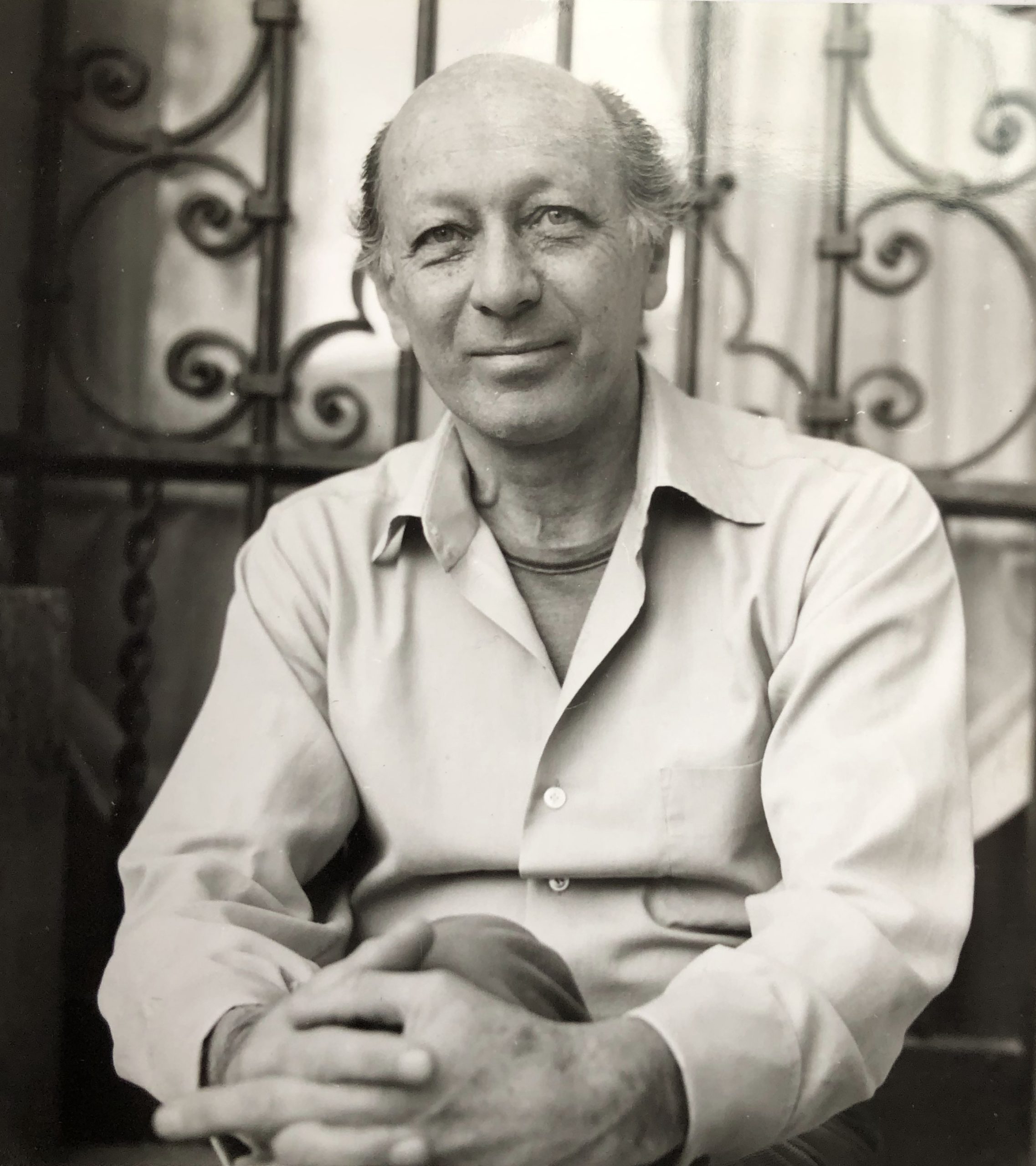
“...a musical force of nature...” San Francisco Chronicle
ROBERT GROVE HUGHES (1933–2022) had a long and multi-faceted career as composer, conductor, performance artist, author and publisher, humanist and lecturer, and Italophile. His vision was sui generis and his compositional gamut wide—from virtuoso works for children’s films to electroacoustic and multi-perceptual experiments for orchestra. He maintained niche interests in Alaskan themes, the pairing of Asian and Western instruments, and radically-staged mixed-media events. Underlying every composition was a deep sense of camaraderie with his peers—the conductors, composers, and musicians with whom he worked—manifested as a challenge, tease, gift or showcase for their personalities and talents. A union musician from his late teens, he was widely sought as a bassoonist and contrabassoonist. His oeuvre is peppered with chamber works for unheard-of combinations among the bass clef instruments.
He was Composer-in-Residence with the San Francisco Symphony (1977) and the Rockefeller Bellagio Center (1989), and a Fulbright Scholar in Italy (1982), and a frequent visiting artist-scholar at the American Academy in Rome. He was inducted into the Buffalo Music Hall of Fame in 2004.
New and Electroacoustic Music
The pairing of pre-recorded electronic tape music with traditional Western instruments reflects the composer’s interest in new timbral experiences, heard through the ear of a tenured orchestral player with an abiding interest in the shared experience of making and listening to music. Notable works include: Quadroquartet (commissioned by the Cabrillo Music Festival), for four flutes, four French Horns, four double basses, and four audio speakers on the stage; Cones (jointly commissioned by Cabrillo and Oakland Ballet), for tape and orchestra, which opens with six and a half minutes of solo sounds from the Moog IIIP; Cadences (commissioned by the Oakland Symphony), for a spatially-deployed double orchestra and tape tracks containing of electronics and pre-recorded, politically-inflected comments by the youth orchestra players. Cadences was later choreographed by John Neumeier for the Hamburg Ballet.
Together, his six electroacoustic works for full orchestra and five for smaller ensembles—all composed over a relatively short period of seven years (1971 to 1977)—stand apart from the better-known postwar investigations of acoustics and technological innovation undertaken in academic or corporate electronic music laboratories.
As one of the Bay Area’s most active conductors of contemporary music, Hughes premiered and recorded mid- to late-twentieth-century works by Beth Anderson, Laurie Anderson, Robert Ashley, Henry Brant, Don Buchla, Luigi Dallapiccola, Robert Erickson, Lou Harrison, Andrew Imbrie, Peter Lopez, Robert Moran, Ami Radunskaya, Ned Rorem, Blue Gene Tyranny, and Olly Wilson. Recordings were issued on the CRI, New World, Cambridge, 1750 Arch, and Bomar labels. Though no premiere or recording was involved, Hughes memorably led the Lyon Opera Ballet in 1990 performances of two ballets by Frank Zappa.
Cabrillo Music Festival
Hughes is remembered most as the founder of ensembles whose mission was to upend traditional music programming. He extended the repertoire to composers who defied description, living Black American composers, poet-composers, and performance art or mixed-media creators. He co-founded the Cabrillo Festival of Contemporary Music with Lou Harrison in 1963, helping to secure the festival’s vibrant commitment to new music, which endures today.
Youth Chamber Orchestra: New and World Music
Hughes shaped a generation of emerging musicians by founding and directing the Youth Chamber Orchestra (YCO) in 1964, which expanded into the Oakland Symphony Youth Orchestra (OSYO). His programming and development for this group were unparalleled. The ensemble commissioned, toured and recorded new music. They staged mixed-media and film “happenings” in concert halls and site-specific environments. They performed music of the California Diaspora from Latin America, China, Japan, and Afghanistan. Their more radical experiments embraced their 1960s counterculture, the civil rights movement, and anti-war protests.
The Black Composer in America
The YCO under Hughes attracted national attention with recordings of works by Henry Brant, Stephen Chambers, Arthur Cunningham, William Dawson, William Fischer, Lou Harrison, Ulysses Kay, William Grant Still, George Walker, Ned Rorem, and Hughes himself. For the 1970 season, Hughes launched The Black Composer in America project, which sought to redress the neglect of Black contemporary composers by major music institutions. The works in this program were taken on a tour of the American South and released on the Desto label as the first of three LPs dedicated to the music of Black American composers.
ASCAP Award for Adventurous Programming
Hughes returned to direct an enlarged OSYO for its 1979-80 season, earning the prestigious ASCAP Award for Adventurous Programming for the group. Works by Laurie Anderson and Olly Wilson were followed by a summer tour of The Rite of Spring that played Hans Werner Henze’s festival Cantiere Internazionale d'Arte in Montepulciano, Italy, and Gustav Mahler’s summer home in Dobbiaco, Italy.
Arch Ensemble for Experimental Music
In the mid 1970s, Hughes and baritone vocalist Thomas Buckner co-founded the Arch Ensemble for Experimental Music—a “one-each-instrument” group in Berkeley CA. Notable members included Nate Rubin (violin), Lorraine Hunt, later Lieberson (viola), and Don Buchla (electronics). They toured the U.S. and Europe, recorded for the 1750 Arch label, and pursued interdisciplinary collaborations that featured performance art by California composers.
Recovery of music with historic significance
Hughes’ research into California history and its Diaspora populations recovered several lost works: songs of the California Gold Rush; Saint-Saëns’ Hail! California from the 1915 Panama-Pacific Exposition; songs by the poet-composer Robert Louis Stevenson; and Hidemaro Konoye’s transcription of Etenraku from the Japanese Gagaku repertory, which was last performed and recorded by Leopold Stokowski with the Philadelphia Orchestra in the 1930s.
His research into Ezra Pound’s first opera Le Testament led to a 1971 staged premiere with the San Francisco Western Opera Theater, which Hughes conducted. The recording on Fantasy Records was later reissued by Second Evening Art, a label Hughes established with his wife, choreographer Margaret Fisher. Between 2003 and 2011, they published facsimile scores and performance editions of the complete musical works of Ezra Pound—a project supported by New Directions Publishers, the Rockefeller Foundation Bellagio Center and the Beinecke Rare Book and Manuscript Library. In 2015, Hughes received the Lifetime Achievement Award from the Ezra Pound Society.
Silenus’ Antiphonary, a multi-perceptual work
Hughes’ final and most ambitious work, Silenus’ Antiphonary, for large and small performing forces and a variety of choirs, serves as an epic love letter to the composer’s beloved symphonic and chamber ensembles. It was published posthumously by the American Composers Edition. The graphic music score utilizes multiple color systems to evoke the cross-sensory experience of chromesthesia (the association of color with sound), as well as synesthesia, a complex phenomenon heightened in this case by placing music notation within a larger assemblage of image, lyrics, and intertexts.
Lectures, Performance Venues and Performance Art
In addition to his creative work, Hughes led art and music tours to Italy. He was a guest lecturer at the Biblioteca Rispoli and American Library in Rome, Kansai University in Osaka; and the San Francisco Symphony, Oakland Symphony, the Exploratorium, Mills College, and the San Francisco Conservatory of Music. He was also a frequent participant in events at the Old Spaghetti Factory, San Francisco Tape Music Center and the Mills College Center for Contemporary Music, as well as storied California performance-art venues like the Berkeley Art Museum and 80 Langton Street.
He was co-artistic director with Fisher of MAFISHCO, a production and touring company based at the 45th Street Artists’ Cooperative in Emeryville, CA. Their experimental Bay Area programs of dance, dance theater, performance art and new media were invited to The Kitchen (NYC), Dance Theatre Workshop (NYC), Sushi Performance and Visual Art (San Diego), the Telluride Ideas Festival, MoMing (Chicago), and the Biennale di Venezia.
Background
Robert Hughes was born in Amherst, New York. He attended the University of Buffalo, where he studied with Aaron Copland and Carlos Chávez. As the University’s student conductor of contemporary music, he hosted a radio show, “This is Good Music” and programmed a new music series with members of the Buffalo Philharmonic. For that series, he brought Lou Harrison out of self-imposed isolation in Aptos, California, to premiere new work—essentially relaunching Harrison’s career.
Additional composition studies with Luigi Dallapiccola in Florence, Italy, and Pierre Boulez at the Darmstadt Summer Course, Germany, alongside conducting studies with Herbert von Karajan at the Mozarteum in Salzburg, preceded a pivotal career shift in 1961. Hughes moved to Aptos to study directly with Harrison. In doing so, he shed East Coast and European formalist musical trends, restarting his compositional approach and beginning a multi-faceted collaboration with Harrison that lasted four decades.
500 word biography
ROBERT GROVE HUGHES (1933–2022) was born in Amherst, New York. At the University of Buffalo he studied composition with Aaron Copland, Carlos Chávez, and Leon Kirchner. His long career was primarily based in the San Francisco Bay Area, where he composed orchestral, chamber, and vocal works, six ballets, eighteen film scores, and a substantial body of electronic music. He was composer-in-residence with the San Francisco Symphony and the Rockefeller Foundation Bellagio Center; visiting artist-scholar at the American Academy in Rome; and a Fulbright Scholar in Italy.
A lifelong advocate for new music, Hughes founded several ensembles to reimagine orchestral programming and expand the visibility of twentieth-century composers. He co-founded the Cabrillo Music Festival with Lou Harrison in 1963 and helped secure its commitment to new music. Festival Director Carlos Chávez commissioned Hughes to create hybrid work for electronics and orchestra (Radiances, 1971). Its immediate success spawned three subsequent works: Auras (1972), Quadroquartet (1973), and Cones (1975).
Hughes shaped a generation of musicians through the Youth Chamber Orchestra (YCO), founded in 1964. The multiethnic ensemble performed and toured widely, proving the viability of innovative and international programming, which included music from Latin America, China, and Japan; works reflecting 1960s counterculture; and music tied to social activism.
His research on California history and diaspora recovered works such as Gold Rush songs, Saint-Saëns’ Hail! California, songs by Robert Louis Stevenson, and Stokowski’s transcription of Etenraku by Hidemaro Konoye.
The YCO attracted national attention through commissions, and recordings of works by Henry Brant, Lou Harrison, Ulysses Kay, William Grant Still, George Walker, Ned Rorem, and Hughes. Addressing the neglect of contemporary Black composers, Hughes launched the project The Black Composer in America, which toured the American South in 1970 and enjoyed a commercial release on Desto Records.
In 1974, Hughes received a commission from the Oakland Symphony for Cadences (1976), a double-orchestra work with spatial deployment and pre-recorded commentary from musicians regarding the Vietnam War and local protest movements. Hamburg Ballet later choreographed a ballet to Cadences. The youth orchestra under Hughes’ direction in 1979 won the ASCAP Award for Adventurous Programming.
Additional studies with Luigi Dallapiccola, Lou Harrison, and Pierre Boulez expanded his artistic range. In the late 1970s, Hughes co-founded with Thomas Buckner the Arch Ensemble for Experimental Music to integrate electronics and cross-disciplinary performance.
As conductor, he premiered works by Laurie Anderson, Don Buchla, Robert Ashley, among others, recorded extensively across multiple labels, and directed two Zappa ballets choreographed by Lucinda Childs and Ralph Lemon. A symphony bassoonist and contrabassoonist, he was also proficient on percussion and the Korean piri.
Hughes premiered and recorded Ezra Pound’s 1923 opera Le Testament (1971). He and his wife, choreographer Margaret Fisher, founded Second Evening Art to issue performance editions of all Pound’s musical works. Their collaboration extended to interdisciplinary performance through the group MAFISHCO.
Late in his career, Hughes lectured widely. His final major work, Silenus’ Antiphonary, published posthumously in 2026, combines music, text, and visual art using synesthetic techniques. Hughes died in 2022 in Emeryville, California.
250 word biography
ROBERT GROVE HUGHES (1933–2022), born in Amherst, New York, studied music composition at the University of Buffalo with Aaron Copland, Carlos Chávez, and Leon Kirchner. Based in the San Francisco Bay Area, he composed orchestral, chamber, and vocal works, ballets, film scores, and electronic music. He was composer-in-residence with the San Francisco Symphony and Rockefeller Bellagio Center, and a Fulbright Scholar in Italy.
A lifelong advocate for new music, Hughes co-founded the Cabrillo Music Festival with Lou Harrison in 1963, helping secure its commitment to contemporary composers. Commissions there included Radiances (1971) and later works combining electronics and orchestra.
In 1964, his founding of the Youth Chamber Orchestra shaped a generation of musicians. The ensemble toured nationally and recorded on the Desto label, specializing in new music, international repertoire, music tied to California history and diaspora, and socially engaged works. Their 1970 project The Black Composer in America addressed the neglect of contemporary Black composers and toured the American South.
Hughes received an Oakland Symphony commission for Cadences (1976), a spatial double-orchestra work incorporating pre-recorded reflections on the Vietnam War. He received the ASCAP Award for Adventurous Programming in 1980.
He co-founded the Arch Ensemble for Experimental Music, integrating electronics and interdisciplinary performance, and conducted premieres of works by Laurie Anderson, Robert Ashley and Ezra Pound, among others.
He collaborated with choreographer Margaret Fisher to create performance art and video programs. His final work, Silenus’ Antiphonary (published 2026), combines music, text, and visual art in a novel synesthetic experiment.