Robert Hughes: A Musical Legacy Finds a New Home in the ACA Catalog
Works spanning seven decades reveal the remarkable range of a composer who moved freely among chamber music, orchestral writing, theater, dance, electronics, and experimental performance.
In 2026, the music of composer Robert Grove Hughes (1933–2022) enters a new chapter with the publication of Hughes’ music in the catalog of the American Composers Alliance. Written primarily from the 1960s through the 1990s, the works reveal a composer with an expansive musical vocabulary—and a seemingly endless curiosity about what could happen when instruments, voices, electronics, movement, poetry, and visual media are brought together.
Rather than a set style, in the Hughes works there is a spirit of exploration, for himself as a bassoonist and conductor, and among the musicians he worked with. The works reflect a composer who consistently looked beyond conventional boundaries of performance.
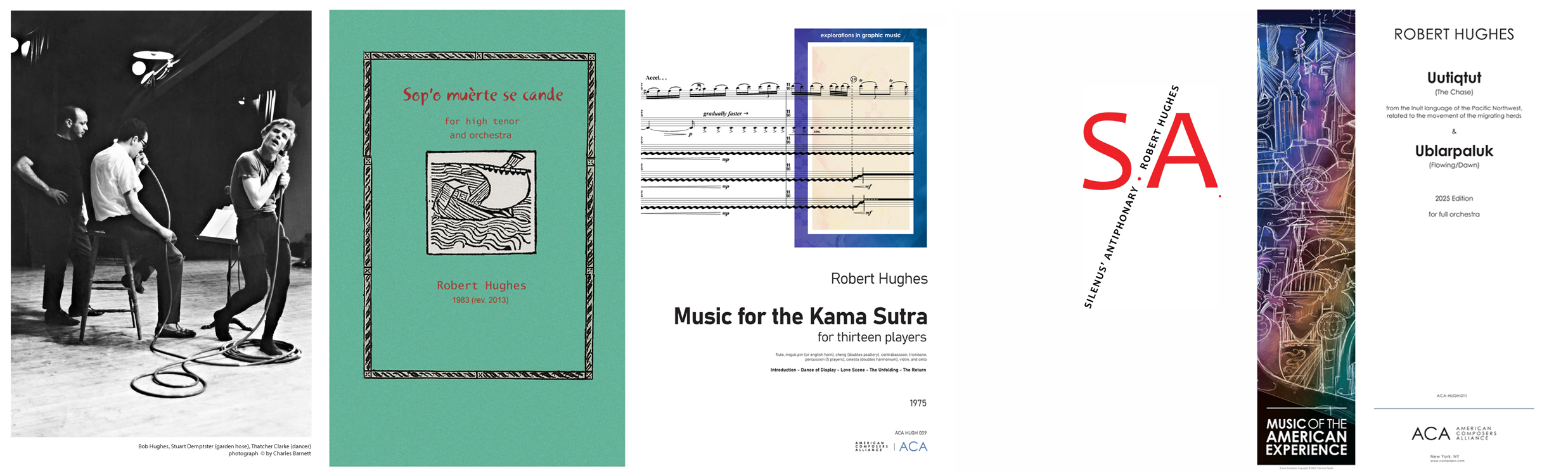
Hughes was a symphonic bassoonist and composed or arranged many works for wind quintet. Other combinations he explored include trombone, percussion, a garden hose, and dance. A piece for three bassoons appears alongside a trio for Mexican clay flute, five coffee cans, and jahlataranga (water bowls). Elsewhere are synthesizers, electronic tracks, koto, cheng, kithara, harp, percussion, children's voices, and multimedia projection.
Three Pieces for Lou, dedicated to composer Lou Harrison, is written for celesta and tack piano. The Sampler pairs three percussionists with harp. Such combinations offer a glimpse into Hughes's approach to sound, where instruments could be chosen for their timbre, their physical presence, their cultural associations, for the players that were in Hughes’ orbit at the time, or simply for the unexpected sounds they could produce together.
That same adventurousness appears in Hughes's more traditionally scored music. The ACA catalog includes numerous works for wind quintets, among them original works Estampie II, Three Cowboy Songs, and Whitehorse Express, as well as arrangements of works by others, such as Putnam's Camp, Schoenbergiana, Serenade in C, and Variations on America.
From concert hall to theater and dance
The ACA catalog includes incidental music for three major plays: Tennessee Williams' The Glass Menagerie; Beckett's Waiting for Godot; and Jean Anouilh's Waltz of the Toreadors. The scores range from a compact combination of violin and vibraphone to flute and trumpet and a larger ensemble comprised of clarinets, trumpets, percussion, guitar, piano, and double bass.
From his Dance Suite, the movement "A Tango" is scored for orchestra and dance, while "Waltz" combines winds and brass with strings. In Anagnorisis, dancers become part of the performing forces themselves and musicians dance. For Hughes, music could be part of a larger theatrical or physical experience rather than something experienced only through listening.
Voices, poetry, and the American experience
His vocal and choral compositions include An Adamant Apple, Madrigal, HCE for 6-part choir, Compleynt, Songs from the Palatine Anthology, Storm Cycle, and Three Poems of Lou Harrison. The works range from unaccompanied mixed chorus to combinations of solo voices, piano, harmonium, contrabassoon, and electronic resources.
Several works engage with American poetry and geography. Storm Cycle, on poetry by the (then) well-known beat poet Hester Storm, for example, calls for a chamber ensemble and SATB voices to evoke San Francisco's Summer of Love. Uutiqtut, an Orchestral Suite (w/Ublarpaluk) similarly connects orchestral music with Native American themes and the Alaskan landscape.
The catalog therefore tells a story not only about musical style, but also about Hughes' interest in literature and cultural traditions.
Electronics—and an expanded idea of the orchestra
Hughes's use of electronics appears in works such as Cones, for orchestra and pre-recorded tape with a 7-minute electronics-only introduction, and Pervigilium Veneris, which calls for voices and a combination of acoustic or synthesized instrumental sounds, strings, harp, piano, and electronic drone.
The largest-scale example may be Silenus' Antiphonary. Its palette includes expanded orchestral forces, choral voices, kithara, cheng, koto, electronics, synthesizer, and multimedia projection. It is a work that effectively dissolves the traditional boundaries among concert music, electronic music, theater, and visual media. Movements from the Antiphonary are available as stand-alone works as well.
This interest in expanded sound worlds is an important part of Hughes's legacy. His music demonstrates that experimentation does not necessarily mean abandoning traditional instruments or forms. Instead, acoustic and electronic resources can coexist, sometimes in innovative combinations.
Music for the next generation
Hughes's experimental interests did not belong exclusively to the world of advanced professional performance. As a conductor who established the Oakland Youth Orchestra, Hughes also wrote with younger performers and their audiences in mind. His connections with youth orchestras introduced young musicians and listeners to unusual sounds, ensembles, American poetry, and world music.
The ACA catalog identifies several works by Hughes as suitable for young audiences. Happy Birthday for New Orleans Jazz Band, Little Big Top, Music for Geraldine, Three Cowboy Songs, Trepak, Usury Canto, These, and Music from the Gold Rush Era, and Whitehorse Express are potential family concert fare.
A legacy brought together
Viewed individually, the works by Hughes in the ACA catalog are exceptionally diverse. Viewed together, they tell a larger story about the legacy of a composer who contributed great energy in support of other artists. Hughes integrated his artistic work with the needs and aspirations of the people around him, leaving an influence on Northern California's musical life that transcended his own generation.
The American Composers Alliance continues to provide performers, conductors, scholars, students, and audiences with performing editions and manuscript scores for more than 100 years of creative activity in composition in the United States. ACA is making available the Hughes scores to the public for the first time, kindling the composer's adventurous spirit anew.
-G. Genova, Aria Music