LOU HARRISON
mentor, colleague & friend
Robert Hughes Papers
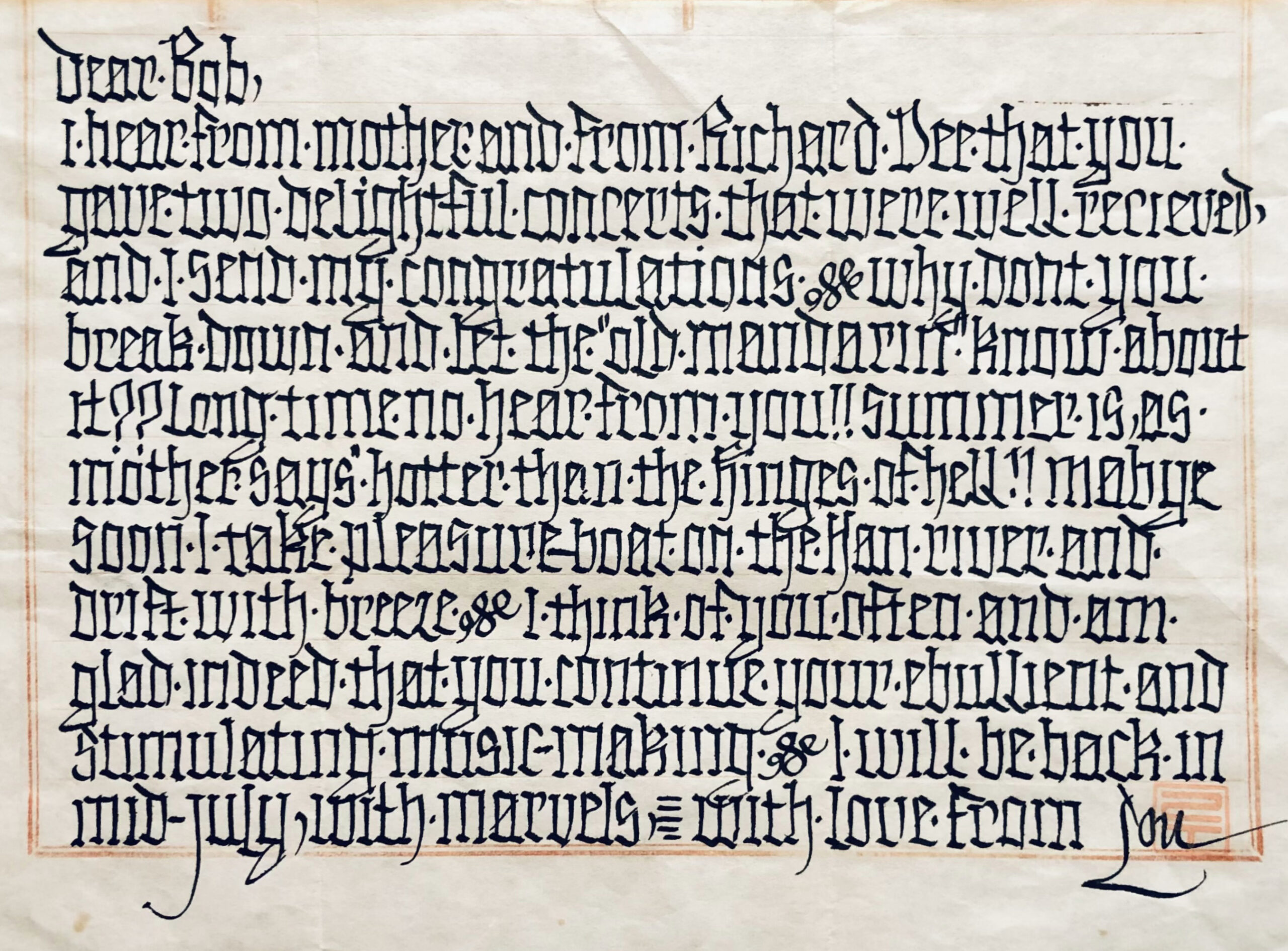
Letter, Lou Harrison to Robert Hughes [Asia, Summer 1961]
"Dear Bob, I hear from mother and from Richard Dee that you gave two delightful concerts that were well received and I send my congratulations why dont you break down and let the 'old mandarin' know about it?? long time no hear from you!! summer is as mother says 'hotter than the hinges of hell!!' maybe soon I take pleasure-boat on the Han river and drift with breeze. I think of you often and am glad indeed that you continue your ebullient and stimulating music-making. I will be back in mid-July, with marvels, with Love from Lou"
Robert Hughes Papers
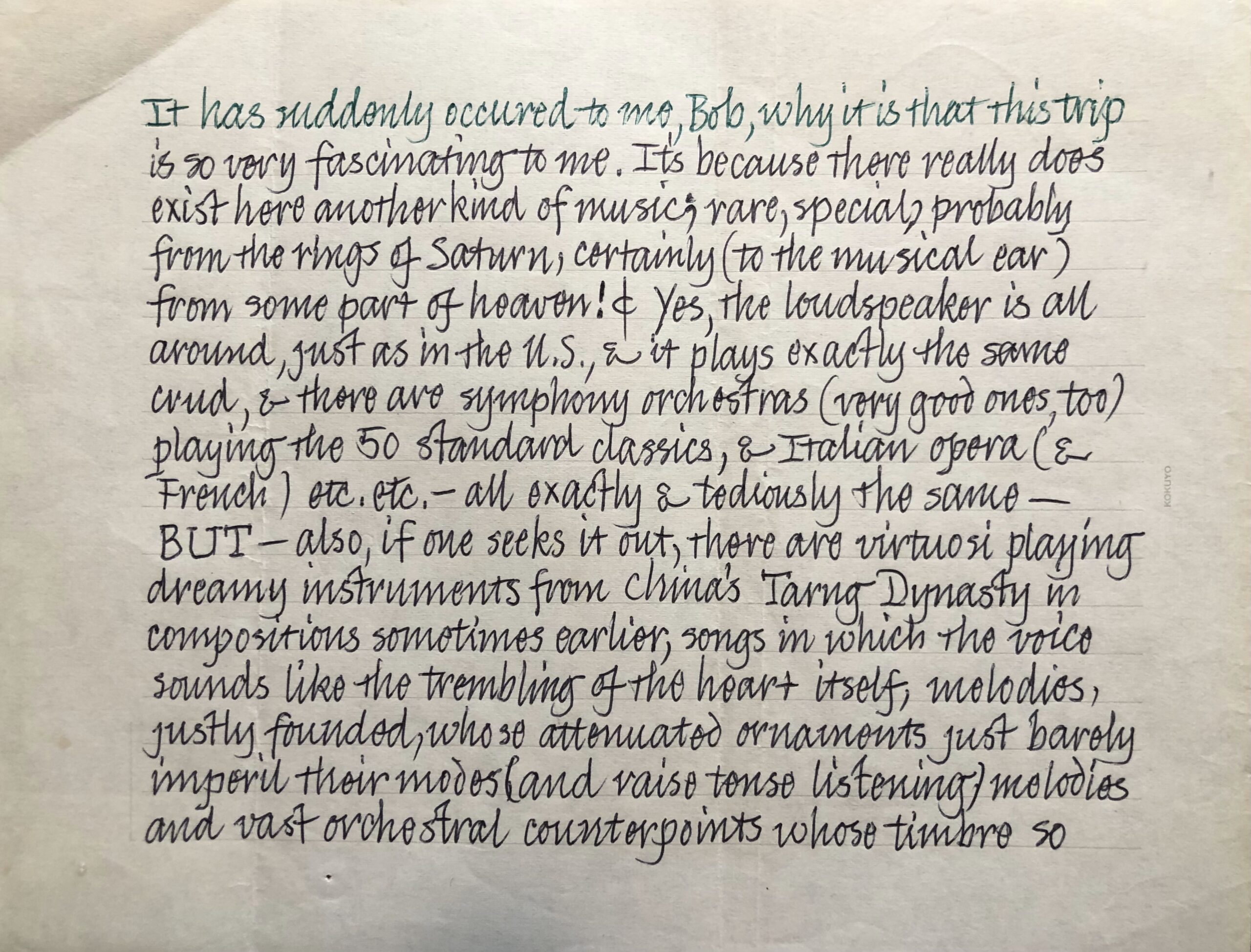
Letter, p.2, Harrison to Hughes [Asia, Summer 1961]
"It has suddenly occurred to me, Bob, why it is that this trip is so very fascinating to me. It's because there really does exist here another world of music; rare, special, probably from the rings of Saturn, certainly (to the musical ear) from some part of heaven! Yes, the loudspeaker is all around, just as in the U.S., & it plays exactly the same crud, & there are symphony orchestras (very good ones, too) playing the 50 standard classics, & Italian opera (& French) etc. etc.—all exactly & tediously the same—BUT—also, if one seeks it out, there are virtuosi playing dreamy instruments from China's Tarng [Tang] Dynasty in compositions sometimes earlier, songs in which the voice sounds like the trembling of the heart itself, melodies, justly founded, whose attenuated arnaments just barely imperil their modes (and raise tense listening) melodies and vast orchestral counterpoints whose timbre so [p. 3, allures that one wishes sometimes that the piece would reach near stopping so that he might relish every overtone.] . . ."
Lou Harrison Papers, McHenry Library, University of California Santa Cruz
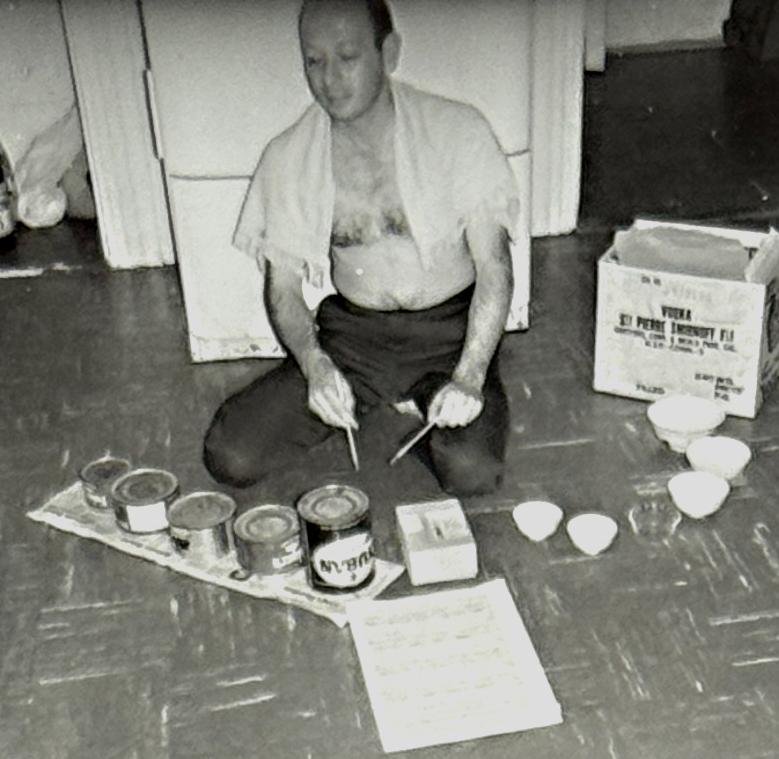
Shirtless: Adjusting to West Coast informality, Hughes, in an apartment next to the Sticky Wicket, rehearses the five coffee cans and tuned bowls of water for his Trio for Mexican Clay Flute, written early in his studies with Harrison.
Robert Hughes Papers
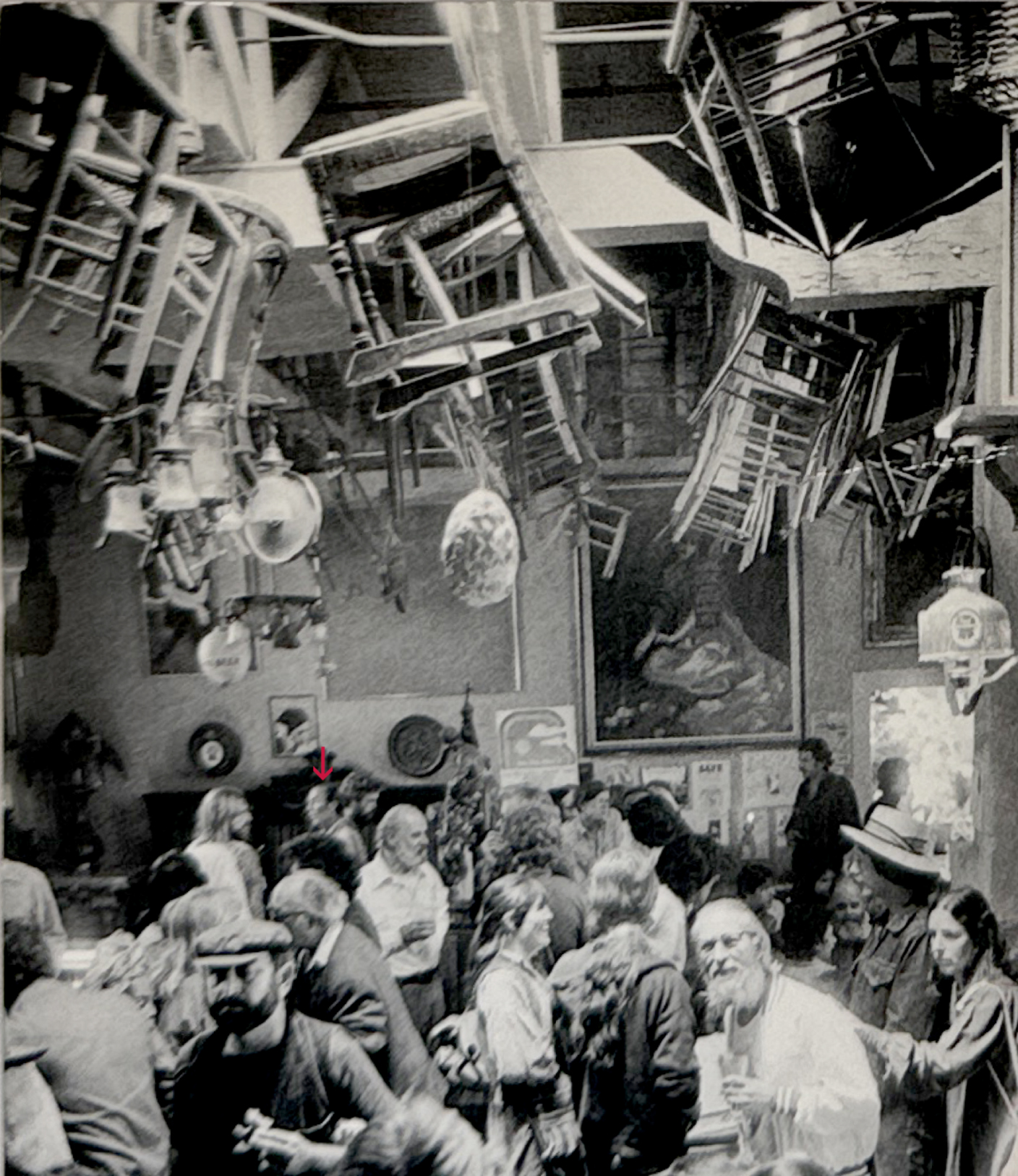
The Old Spaghetti Factory, San Francisco, with chairs hanging from the ceiling. A red arrow points to Robert Hughes. Robert Hughes Papers
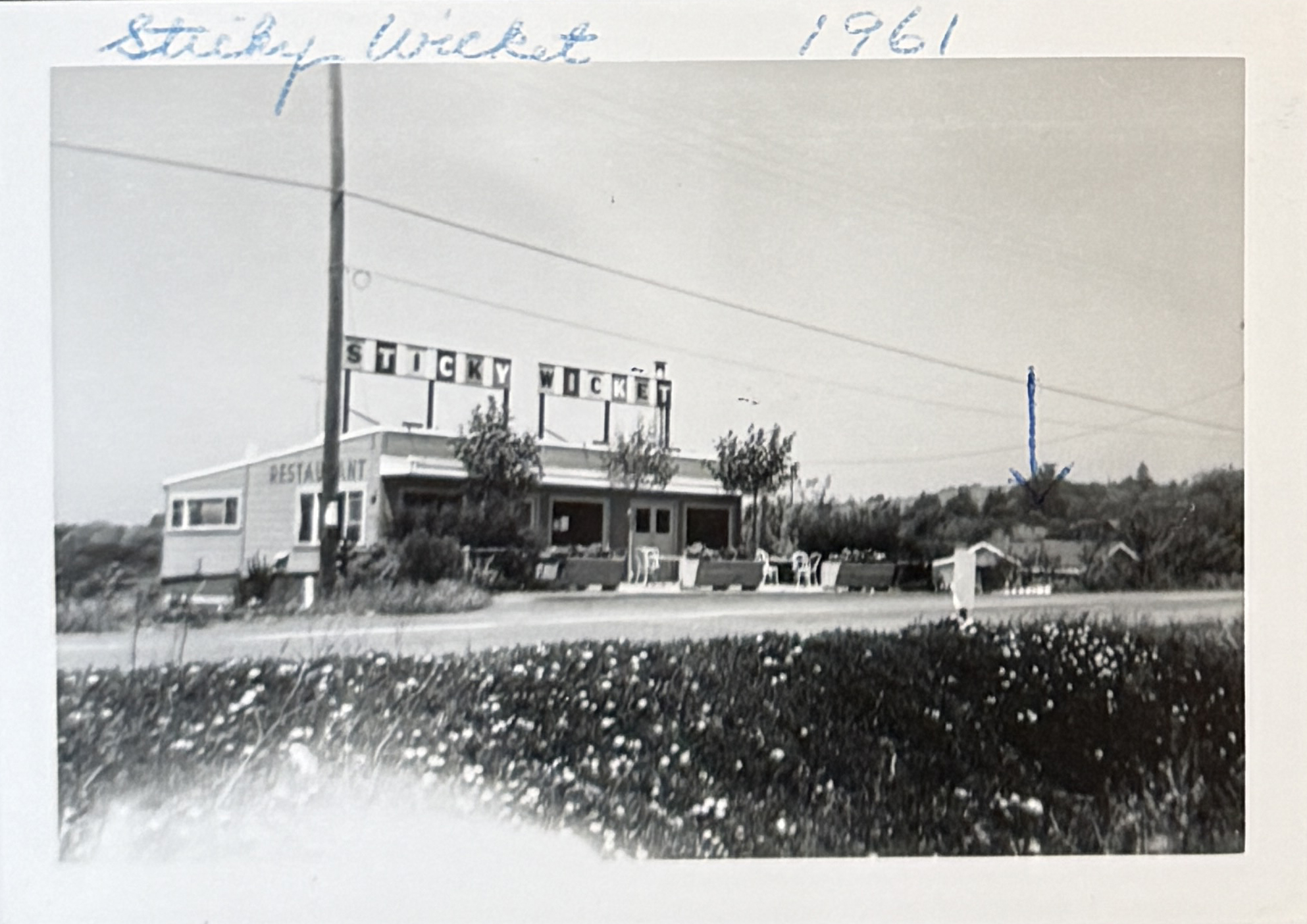
Vic & Sidney Jowers' Sticky Wicket Cafe, Highway 1, Aptos CA Robert Hughes Papers
Overview
ROBERT HUGHES AND LOU HARRISON, Four Decades | audio interviews below
Robert Hughes became acquainted with Lou Harrison’s music while a graduate student at the University of Buffalo and radio host of “This is good music,” a broadcast of new music by the Buffalo station WKBW. Finding Harrison’s Suite for Cello and Harp a refreshing departure from the usual standard modernism, Hughes, as director of UB’s concert series for contemporary music, invited Harrison to the university. Harrison offered the premiere of his “Recitatives in Esperanto” from his Political Primer (to be sung by Herbert Beattie). Hughes conducted this work, as well as the “Prayer Scene” from Harrison’s opera Rapunzel, and Solstice for two concerts, May 23 & 24, 1959.
Following a year of composition studies with Luigi Dallapiccola in Florence, Italy and conducting studies at the Mozarteum in Vienna, Hughes arrived in Aptos CA in January 1961 to study with Harrison. Lessons first addressed the creative juices that had dried during Hughes’ study of twelve-tone serialism. Within a few months, Hughes was on the floor rehearsing coffee cans and bowls of water for his new Trio for Mexican Clay Flute, clearly influenced by Harrison’s approach to percussion and melody (image 2).
Lessons proceeded until March 25th when Harrison left for his first trip to Asia. He returned four months later to find Hughes running a new concert series and a summer program with Vic and Sidney Jowers, owners of The Sticky Wicket, a cafe in Aptos with books, folk music, and now, chamber music and theater. The venue would give Harrison an opportunity to emerge from a self-imposed solitude to hear his newly composed works. He embraced this community of highly skilled musicians, along with many admirers who would remain devoted to him throughout his lifetime. The cafe was the site of many important musical and personal events which expanded the careers of both men. It closed in 1964, yielding to the expansion of the coast highway.
Lessons resumed from the end of July to the following summer when Harrison once again departed for Asia, this time for five months. Hughes, a professional bassoonist, used the occasion to relocate to San Francisco to play with the major Bay Area orchestras, take up contrabassoon, and assume positions as Assistant Conductor for the San Francisco Ballet and Oakland Symphony Orchestras. He was a frequent participant in the experimental music scene at the San Francisco Tape Music Center and at Mills College. Ideally situated to advise as well as to program Harrison’s music, Hughes brought Harrison north for concerts, particularly for performances at The Old Spaghetti Factory in North Beach, the cafe/music venue where he introduced Harrison to an electrician named Bill Colvig, a regular at the Spaghetti Factory. Colvig and Harrison became life partners.
One of the more experimental concerts at the S. F. Tape Music Center featured the world premiere of Sonorous or Exquisite Corpses, co-written as a late night “parlour game” in New York in the 1940s by Harrison, John Cage, Henry Cowell, Virgil Thomson, and Frank Wigglesworth. Hughes arranged the work for his West Coast Wind Quintet. He arranged two other Harrison works, both tributes to Schoenberg: Schoenbergiana and Serenade in C.
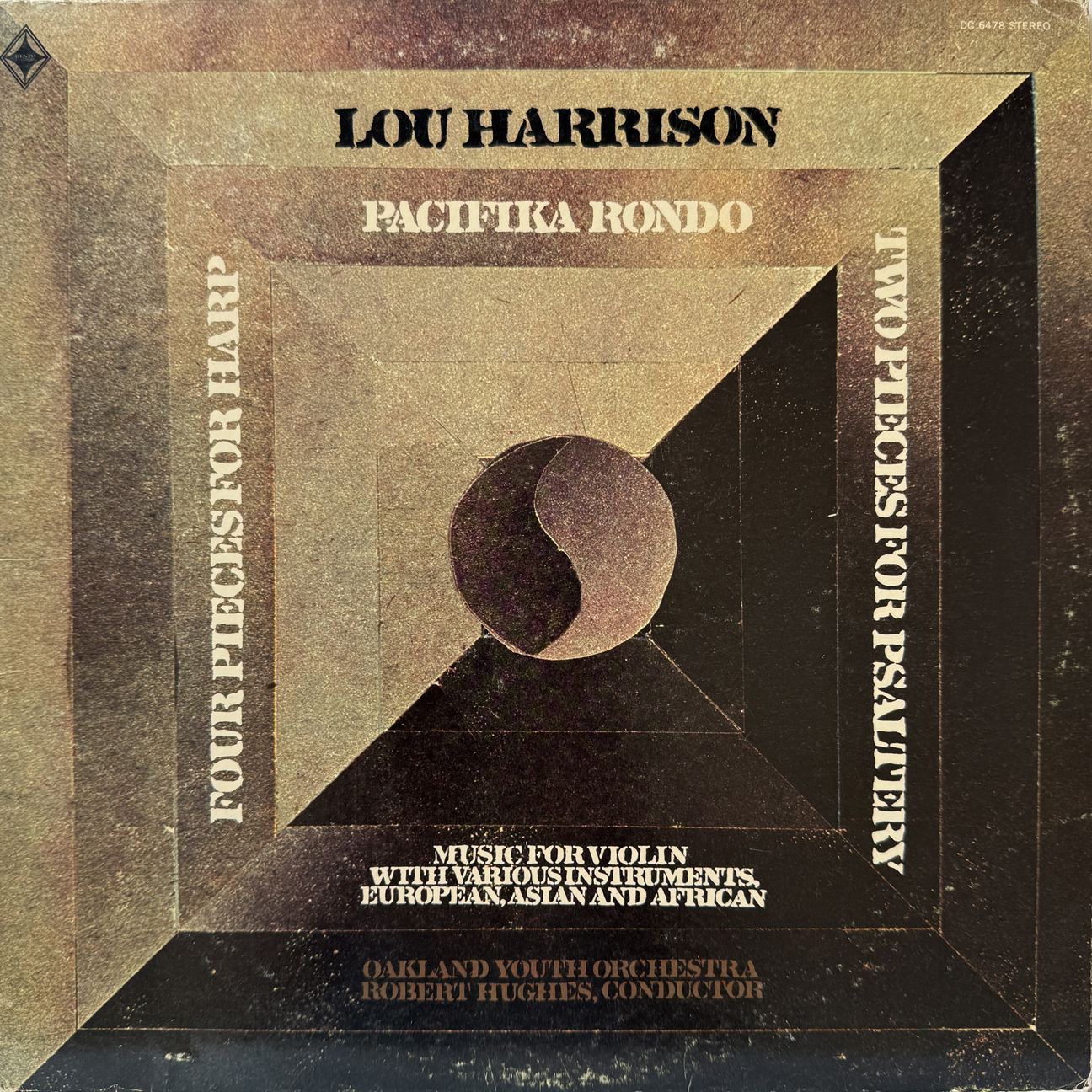
Hughes conducted Harrison’s music regularly. A short list includes the world premiere and recording of Concerto in Slendro (1961), the American premiere and recording of Pacifika Rondo (1963), and several performances of Suite for Violin, Piano and Small Orchestra, all at the Sticky Wicket, and the world premieres of Harrison’s opera Young Caesar (1977 for puppets; 1988 for humans).
Harrison in turn dedicated two works to Hughes: Quintal Taryung (1961), and Garden at One & A Quarter Moons (1964); and wrote two solos for him: Prelude for Piri and Reed Organ (Hughes on reed organ, Harrison on piri, premiered in 1961) and Homage to Pacifica (Hughes on bassoon, 1991).
The Sticky Wicket was the site of many important musical and personal events which expanded the careers of both men. It closed in 1964, yielding to the expansion of the coast highway. Choral Director Ted Toews at the new Cabrillo College in Aptos had been consulting with Harrison and Hughes about community uses for the school’s excellent concert hall. Out of those discussions the Cabrillo Music Festival was formed, with Harrison and Hughes credited as co-founders. Hughes suggested Oakland Symphony’s Maestro Gerhard Samuel as the Festival’s Music Director and introduced Samuel to Harrison’s music. Harrison‘s access to Bay Area ensembles and audiences increased multifold.
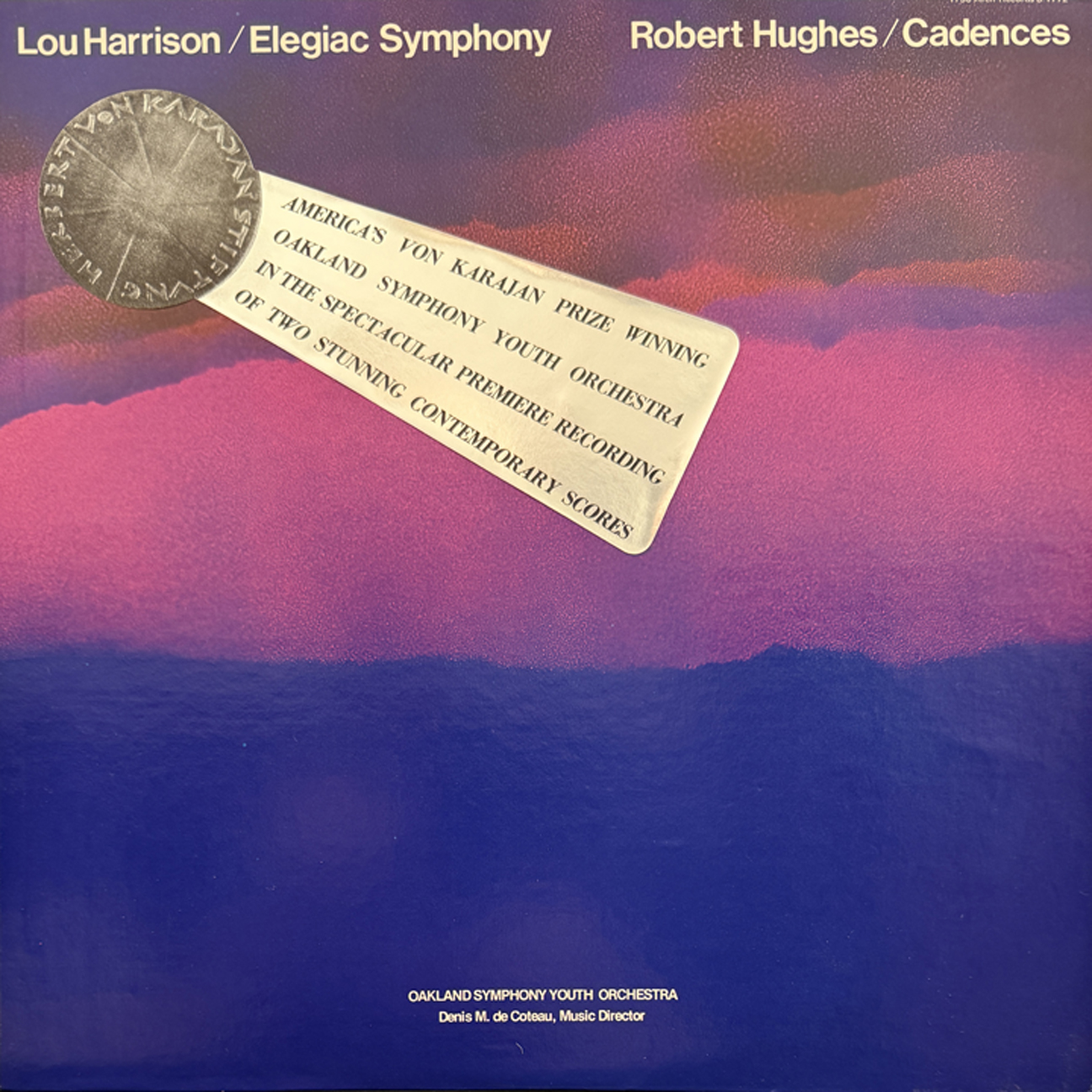
Meanwhile, Hughes founded the Youth Chamber Orchestra (YCO) in 1964 under the umbrella of the Oakland Symphony with the support of Maestro Samuel, who was also a composer. With an emphasis on contemporary and world music, Hughes trained the young musicians to play Harrison’s work and other non-standard repertoire. Their 1971 release of Harrison’s Pacifika Rondo on the Desto label, remains today as the only recording of that work (re-released as an audio CD on the Phoenix label). Their repertoire included Harrison’s transcription for orchestra of the traditional Afghani melody Song of Badarshan. An expanded Oakland Symphony Youth Orchestra would go on to record Harrison’s Elegiac Symphony for the 1750 Arch label. The flip side of the disc features Hughes’ Cadences, a commissioned two-orchestra work with tape and electronic tracks.
Hughes had met and assistant conducted Copland, Brant, Rorem and Chavez while they were Slee (Sinfonietta) Composers in Residence at the University of Buffalo. With Harrison at his back, Hughes was able to draw these artists into various of his California projects. He commissioned new works from Brant and Rorem and invited Copland to California to meet the young soloist who would play his Clarinet Concerto. Rorem facilitated the YCO introduction to Desto Records as he wanted to add their performance of his YCO-commissioned work Water Music to a forthcoming album. Harrison and Colvig later joined YCO’s tour of the Southwest as featured soloists on the concerts, along with Richard Dee, mentioned in Harrison’s letter from Asia, reproduced on this page.
By 1970, the Hughes-Harrison association entailed an active network of venues and musicians. This was in addition to Harrison’s many other networks—the Black Mountain College and New York friendships; the Just Intonation colleagues including Harry Partch; and the Society for Individual Rights (S.I.R.), to name a few. The Society specialized in queer rights to provide a safe environment for cultural programs, which Hughes occasionally conducted or played.
Hughes kept a demanding schedule as a conductor and performer. By the mid 1960s he was composing full time—chamber works for film, voice, and for ballet, modern and baroque dance, the emphasis on dance also owing to Harrison, who throughout his life participated in dance events and composed music for dancers.
From 1971 Hughes turned to the Moog IIIP synthesizer through the public access program at Mills College Center for Contemporary Music, new home of the San Francisco Tape Music Center. Chavez offered him four commissions for the Cabrillo Festival orchestra to pursue this interest. The first of these, Radiances, was well received by audiences and the press. His interest for the next decade, then, centered on the new sonorities that could be created by combining electronic and acoustic instruments. By contrast, in the mid 1970s Harrison fully embraced the gamelan orchestra and its sonorities. Though Harrison‘s and Hughes’ professional interests diverged somewhat, they worked closely every summer at the Cabrillo Festival on one enthusiasm or another. In the mid1980s when Harrison began revisions for his early puppet opera, Young Caesar, scheduled for a staged premiere 1988 by the Portland Gay Men‘s Chorus, with Hughes conducting.
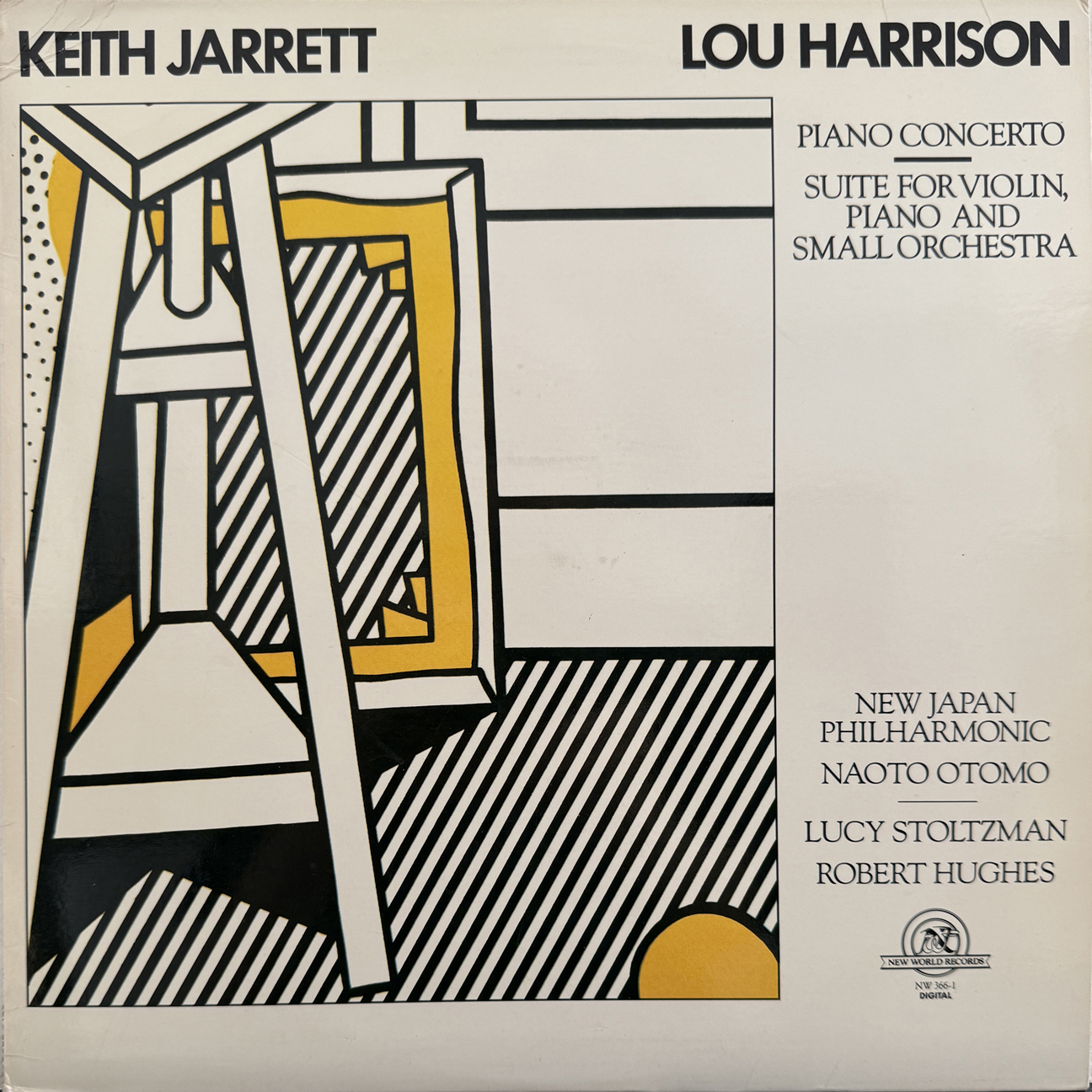
Other projects followed. Hughes recorded Harrison’s Suite for Violin Piano and Small Orchestra with Lucy Stoltzman and Keith Jarrett in 1988 for New World Records. In 1991 he arranged Harrison‘s two early suites for cello into a single new work for Emil Miland, Suites for Cello and String Orchestra. From the early 1990s Hughes helped edit Harrison’s vast trove of poetry for publication. Joys & Perplexities, published by the Jargon Society in 1992. The volume is dedicated to Hughes, who also consulted on a second volume of late poems, The Path at West Holding and Other Poems, released posthumously by Cafe Margo in 2013. From 1987 until Harrison’s death, Hughes was consultant and overseer of music that Harrison prepared for self-publishing under the imprimatur Hermes Beard Press that he created with Bill Colvig, and for larger works destined for Harrison’s commercial publishers. Among the latter were Fourth Symphony; Parade for M.T.T.; and Concerto for P’i-p’a with String Orchestra. Hughes frequently was asked to speak publicly about his work and friendship with Harrison, and to comment on final drafts of dissertations, articles and books by others, such as Lou Harrison, Composing a World by Leta Miller and Fredric Lieberman. Excerpts from taped interviews for the most recent biography, Lou Harrison, American Musical Maverick by Bill Alves and Brett Campbell, are found below.
Postscript
The Hughes-Harrison association and friendship was filled with shared enthusiasms. I switch to a first-name basis to relate a sense of the friendship itself. When it was time for Bob to introduce me, his new partner, to Lou and Bill, he cooked a French menu passed down from Louis XIV. We sat at the lovely composing table Henry Cowell had given to Lou, who generously gifted the table to Bob. I would become Lou’s music copyist. The above narrative with the emphasis on activities and influence, does not do justice to the affection, respect, generosity, and joy that graced Harrison’s and Hughes’ aesthetic and intellectual pursuits. With Trailblazin’ Bill Colvig, they even climbed Mt. Whitney together.
M. Fisher, Trustee, Robert Hughes Papers, October 27, 2026
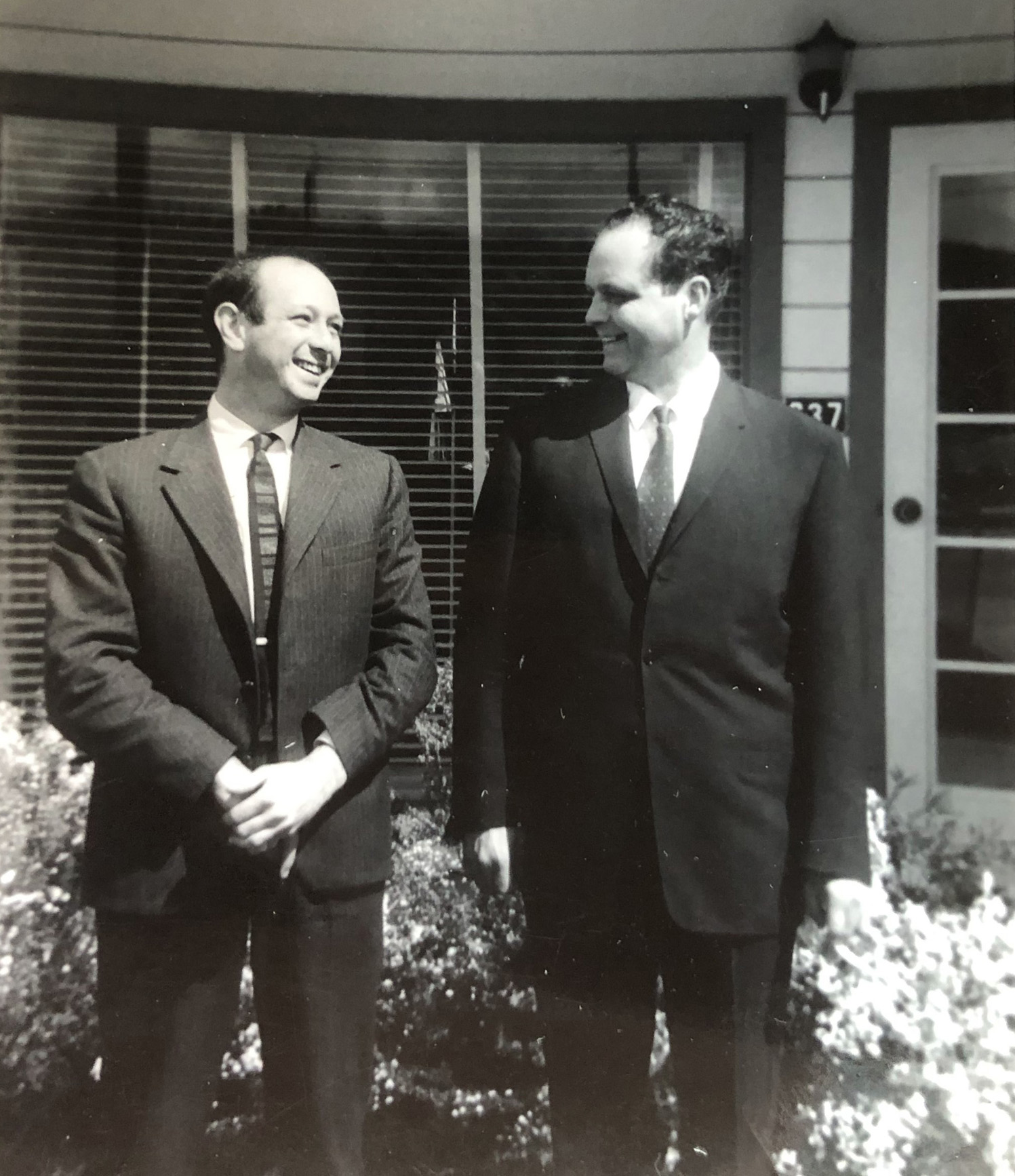
Hughes and Harrison, 1961
Robert Hughes Papers
Overview
robert hughes and lou harrison: four decades of friendship | audio interviews follow
Robert Hughes became acquainted with Lou Harrison’s music while a graduate student at the University of Buffalo and radio host of “This is good music,” a broadcast of new music by the Buffalo station WKBW. Finding Harrison’s Suite for Cello and Harp a refreshing departure from the usual standard modernism, Hughes, as director of UB’s concert series for contemporary music, invited Harrison to the university. Harrison offered the premiere of his “Recitatives in Esperanto” from his Political Primer (to be sung by Herbert Beattie). Hughes conducted this work, as well as the “Prayer Scene” from Harrison’s opera Rapunzel, and Solstice for two concerts, May 23 & 24, 1959.
Following a year of composition studies with Luigi Dallapiccola in Florence, Italy and conducting studies at the Mozarteum, Hughes arrived in Aptos CA in January 1961 to study with Harrison. Lessons first addressed the creative juices that had dried during Hughes’ study of twelve-tone serialism. Within a few months, Hughes was on the floor rehearsing coffee cans and bowls of water for his new Trio for Mexican Clay Flute, clearly influenced by Harrison’s approach to percussion and melody (image 2).
Lessons proceeded until March 25th when Harrison left for his first trip to Asia. He returned four months later to find Hughes running a new concert series and a summer program with Vic and Sidney Jowers, owners of The Sticky Wicket, a cafe in Aptos with books, folk music, and now, chamber music and theater. The venue would give Harrison an opportunity to emerge from a self-imposed solitude to hear his newly composed works. He embraced this community of highly skilled musicians, along with many admirers who would remain devoted to him throughout his lifetime. The cafe was the site of many important musical and personal events which expanded the careers of both men. It closed in 1964, yielding to the expansion of the coast highway.
Lessons resumed from the end of July to the following summer when Harrison once again departed for Asia, this time for five months. Hughes, a professional bassoonist, used the occasion to relocate to San Francisco to play with the major Bay Area orchestras, take up contrabassoon, and assume positions as Assistant Conductor for the S. F. Ballet and Oakland Symphony Orchestras. He was a frequent participant in the experimental music scene at the San Francisco Tape Music Center and at Mills College. Ideally situated to advise as well as to program Harrison’s music, Hughes brought Harrison north for concerts, particularly for performances at The Old Spaghetti Factory in North Beach, the cafe/music venue where he introduced Harrison to an electrician named Bill Colvig, a regular at the Spaghetti Factory.
One of the more experimental concerts at the S. F. Tape Music Center featured the world premiere of Sonorous or Exquisite Corpses, co-written as a late night “parlour game” in New York in the 1940s by Harrison, John Cage, Henry Cowell, Virgil Thomson, and Frank Wigglesworth. Hughes arranged the work for his West Coast Wind Quintet. He arranged two other Harrison works, both tributes to Schoenberg: Schoenbergiana and Serenade in C.
Hughes conducted Harrison’s music regularly. A short list includes the world premiere and recording of Concerto in Slendro (1961), the American premiere and recording of Pacifika Rondo (1963), several performances and a recording of Suite for Violin, Piano and Small Orchestra (featuring Lucy Stoltzman and Keith Jarrett, soloists), all at the Sticky Wicket, a recording of Elegiac Symphony, and the world premieres of Harrison’s puppet opera Young Caesar (1977 for puppets; 1988 for humans).
Harrison in turn dedicated two works to Hughes: Quintal Taryung (1961), and Garden at One & A Quarter Moons (1964) (image below); and wrote two solos for him: Prelude for Piri and Reed Organ (Hughes on reed organ, Harrison on piri, premiered in 1961) and Homage to Pacifica (Hughes on bassoon, 1991).
The Sticky Wicket was the site of many important musical and personal events which expanded the careers of both men. It closed in 1964, yielding to the expansion of the coast highway. Choral Director Ted Toews at the new Cabrillo College in Aptos had been consulting with Harrison and Hughes about community uses for the school’s excellent concert hall. Out of those discussions the Cabrillo Music Festival was formed, with Harrison and Hughes credited as co-founders. Hughes suggested Oakland Symphony’s Maestro Gerhard Samuel as the Festival’s Music Director and introduced Samuel to Harrison’s music. Harrison‘s access to Bay Area ensembles and audiences increased multifold.
Meanwhile, Hughes founded the Youth Chamber Orchestra (YCO) in 1964 under the umbrella of the Oakland Symphony with the support of Maestro Samuel, who was also a composer. With an emphasis on contemporary and world music, Hughes trained the young musicians to play Harrison’s work and other non-standard repertoire. Their 1971 release of Harrison’s Pacifika Rondo on the Desto label, as of today, is the only recording (re-released as an audio CD on the Phoenix label). Their repertoire included Harrison’s transcription for orchestra of the traditional Afghani melody Song of Badarshan. would go on to record Harrison’s Elegiac Symphony for the 1750 Arch label. The flip side of the disc features Hughes’ Cadences, a two-orchestra work with tape and electronic tracks.
Hughes had met (and conducted) Copland, Brant, Rorem and Chavez at the University of Buffalo. With Harrison at his back, Hughes was able to draw these artists into various of his new projects. He commissioned new works from Brant and Rorem and invited Copland to California to meet the young soloist who would play his Concerto for Clarinet. Rorem facilitated the YCO introduction to Desto Records as he wanted to add their performance of his commissioned work Water Music to a forthcoming album. Harrison and Colvig later joined YCO’s tour of the Southwest as featured soloists on the concerts, along with Richard Dee, mentioned in Harrison’s letter from Asia reproduced here.
By 1970, the Hughes-Harrison association entailed an active network of venues and musicians. This was in addition to Harrison’s many other networks—the Black Mountain College and New York friendships; the Just Intonation colleagues including Harry Partch; and the Society for Individual Rights (S.I.R.), to name a few. The Society specialized in queer rights to provide a safe environment for cultural programs, which Hughes occasionally conducted or played.
Hughes kept a demanding schedule as a conductor and performer. By the mid 1960s he was composing full time—chamber works for film, voice, and for ballet, modern and baroque dance, the emphasis on dance also owing to Harrison, who throughout his life participated in dance events and composed music for dancers.
From 1971 Hughes turned to the Moog IIIP synthesizer through the public access program at Mills College Center for Contemporary Music, new home of the S. F. Tape Music Center. Chavez offered him four commissions for the Cabrillo Festival orchestra to pursue this interest. The first of these, Radiances, was well received by audiences and the press. His interest for the next decade centered on the new sonorities that could be created by combining electronic and acoustic instruments. By the mid 1970s, Harrison fully embraced the gamelan orchestra and its sonorities. Harrison‘s and Hughes’ paths diverged until the mid1980s when Harrison began revisions for his early puppet opera, Young Caesar, scheduled for a staged premiere 1988 by the Portland Gay Men‘s Chorus with Hughes conducting.
Other projects followed. Hughes He recorded Harrison’s Suite for Violin Piano and Small Orchestra with Lucy Stoltzman and Keith Jarrett in 1988 for New World Records. In 1991 he arranged Harrison‘s two early suites for cello as a new work for Emil Miland, Suites for Cello and String Orchestra. From the early 1990s Hughes helped edit Harrison’s vast trove of poetry for publication. Joys & Perplexities, published by the Jargon Society in 1992, is dedicated to Hughes, who also consulted on a second volume of late poems, The Path at West Holding and Other Poems, released posthumously by Cafe Margo in 2013. From the years from 1987 until Harrison’s death Hughes was consultant and overseer of music that Harrison prepared for self-publishing under the imprimatur Hermes Beard Press, and for larger works destined for Harrison’s commercial publishers. Among the latter were Fourth Symphony; Parade for M.T.T.; and Concerto for P’i-p’a with String Orchestra. Hughes frequently was asked to speak publically about his work and friendship with Harrison and to comment on final drafts of dissertations, articles and books such as Lou Harrison, Composing a World by Leta Miller and Fredric Lieberman. Excerpts from taped interviews for Harrison’s biography Lou Harrison, American Musical Maverick by Bill Alves and Brett Campbell are found below.
Afterward
The Hughes-Harrison association and friendship was filled with shared enthusiasms. I switch to a first-name basis to relate a sense of the friendship itself. When it was time for Bob to introduce me, his new partner, to Lou and Bill, he cooked a French menu passed down from Louis XIV. We sat at the lovely composing table Henry Cowell had given to Lou, who generously gifted the table to Bob. I would become Lou’s music copyist. The above narrative with the emphasis on activities and influence, does not do justice to the affection, respect, generosity, and joy that graced Harrison’s and Hughes’ aesthetic and intellectual pursuits. With Trailblazin’ Bill Colvig, they even climbed Mt. Whitney together.
M.Fisher, October 27, 2026
Dear Bob, I hear from mother and from Richard Dee that you gave two delightful concerts that were well received and I send my congratulations why dont you break down and let the ”old mandarin” know about it?? long time no hear from you!! summer is as mother says “hotter than the hinges of hell!!” maybe soon I take pleasure-boat on the Han river and drift with breeze. I think of you often and am glad indeed that you continue your ebullient and stimulating music-making. I will be back in mid-July, with marvels, with Love from Lou
Robert Hughes Papers
Letter, p. 2 of 5, Lou Harrison to Robert Hughes from Asia
[Summer, 1961]
Lou Harrison Papers, McHenry Library, University of California at Santa Cruz
The Old Spaghetti Factory, San Francisco, with chairs hanging from the ceiling. A red arrow points to Robert Hughes. Robert Hughes Papers
Illuminating Interviews
Bill Alves & Brett Campbell, authors of Lou Harrison An American Maverick, interview Robert Hughes at his home in Emeryville CA in 2004. Used with permission.
New articles that augment the above Overview can be accessed with the News menu